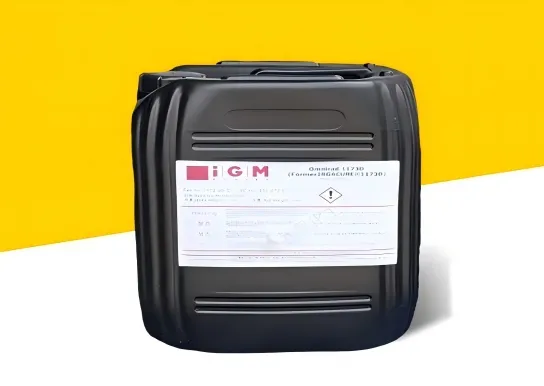
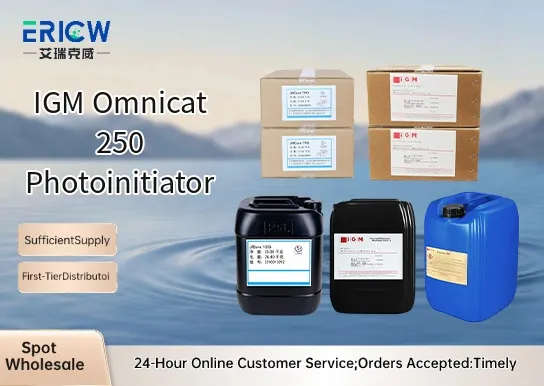
Features Of IGM Omnicat BL 550 UV Photoinitiator
Reactive blend synergism - Multi-component blend synergy, high reactivity and excellent cationic curing efficiency
Colored system adaptation - Designed for colored inks, not affected by various sensitizers, no damage to coloring effect
Benzene-free low-odor easy processing - Benzene-free formula, extremely low odor, low viscosity and good fluidity, easy to add and mix
High solvent resistance and adhesion - Strong solvent resistance, low shrinkage after polymerization, excellent film-substrate adhesion
Multi-system compatibility - Suitable for epoxy, oxetane and other systems, applicable to various harsh curing scenarios
Typical Applications Of IGM Omnicat BL 550 UV Photoinitiator
Colored cationic inks - Various colored cationic UV inks, fast curing, stable coloring without fading
Can coatings field - Cationic UV coatings for cans, high solvent and corrosion resistance, suitable for food contact-related packaging
Coil coatings field - UV-curable coil coatings, low shrinkage, strong adhesion, suitable for continuous production
Pharmaceutical packaging field - UV inks/varnishes for pharmaceutical packaging, benzene-free and low odor, meeting strict compliance requirements
Epoxy system coatings - Epoxy-based UV protective coatings, usable in precision scenarios like OLED encapsulation, stable performance
Specifications Of IGM Omnicat BL 550 UV Photoinitiator
| Brand | IGM (Omnicat® series) |
| Chemical Type | Reactive polymeric cationic UV photoinitiator blend |
| Alias | Mixture of 20% Omnicat 550 in 25% Propylene Carbonate and 55% UVR 6105 |
| CAS No | 591773-92-1 + 108-32-7 + 2386-87-0 (blend components) |
| Appearance (25℃) | Pale yellow to yellow transparent viscous liquid |
| Purity | ≥98.0% |
| Viscosity (25℃) | 30-50mPa·s |
IGM Omnicat BL 550 UV Photoinitiator – Frequently Asked Questions (FAQ)
Q1: What is the primary photoreactivity profile of Omnicat BL 550?
A: Omnicat BL 550 is a highly efficient, low-migration benzophenone-based photoinitiator optimized for long-wavelength UV-A and visible light curing systems. It exhibits strong absorption in the 320–400 nm range and enables rapid surface and through-cure in demanding applications such as coatings and inks.
Q2: How does Omnicat BL 550 compare to conventional Type II photoinitiators in terms of odor and volatility?
A: Omnicat BL 550 is specifically engineered for reduced volatility and minimal residual odor post-cure, making it suitable for sensitive applications like packaging inks and interior coatings where low VOC and sensory impact are critical.
Q3: Is Omnicat BL 550 compatible with acrylate-based and hybrid resin systems?
A: Yes — Omnicat BL 550 demonstrates excellent compatibility with multifunctional acrylates, epoxy acrylates, and hybrid urethane-acrylate formulations. It functions effectively in both 100% solids and low-VOC solvent-borne systems without compromising shelf stability or cure speed.
Q4: What is the typical dosage range for Omnicat BL 550 in UV-curable formulations?
A: Dosage depends on formulation requirements, substrate, and lamp output, but it is typically used at low concentrations — generally ranging from 0.1% to 2% by weight — to achieve full cure while maintaining low migration potential and film clarity.
Q5: Can Omnicat BL 550 be used in food-contact compliant coatings?
A: Omnicat BL 550 is designed with low-migration characteristics and is commonly selected for food packaging applications where regulatory compliance is required; however, final regulatory approval must be verified per jurisdiction and end-use conditions by the formulator.
 English
 Español
 tiếng việt
 русский