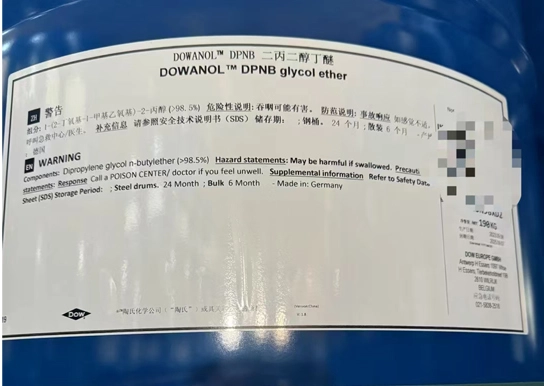
Applications of DPNB(Dipropylene Glycol Monomethyl Ether) CAS No. 29911-28-2
Coupling agent and solvent in household and industrial cleaners, grease and paint removers, metal cleaners, and hard surface cleaners.
Effective coalescent for lowering minimum film formation temperature MFFT) in water-borne latex coatings.
Active solvent for solvent-based coatings.
Chemical intermediate for the production ofepoxides, acid ester derivatives, solvents, and plasticizers.
Effective solvent for water-reducible coatings.
Typical Physical Properties of DPNB(Dipropylene Glycol Monomethyl Ether) CAS No. 29911-28-2
| Property | Value |
| Molecular Weight (g/mol) | 190.3 |
| Boiling Point@ 760 mmHg, 1.01 ar | 230 °C (446 °F) |
| FlashPoint (Setaflash Closed Cup | 100.4 °C (212.7 °F) |
| Freezing Point | <-75 °C (<-103°F) |
| Vapor pressure@ 20°C — extrapolated | 0.04 mmHg |
| Specific gravity (25/25°C) | 0.91 |
| Liquid Density @ 20°C @ 25°C | 0.913 g/cm3 0.907 g/cm3 |
| Vapor Density (air = 1) | 6.6 |
| Viscosity (mm2/s @ 25°C) | 4.9 |
| Surface tension (dynes/cm or mN/m @ 20°C) | 28.8 |
| Specific heat (J/g/°C @ 25°C) | 1.79 |
| Heat of vaporization (J/g) at normal boiling point | 252 |
| Netheat of combustion (kJ/g) — predicted @ 25°C | 30.8 |
| Autoignition temperature | 194°C (381 °F) |
| Evaporation rate (n-butyl acetate = 1.0) | <0.01 |
| Solubility, g/100or % @ 25°C Solvent in water | 4% |
| Water in solvent | 10.40% |
| Hansen solubility parameters |
|
| (J/cm³)1/2 |
|
| _d (Dispersion) | 14.8 |
| _p (Polar) | 2.5 |
| _h (Hydrogen bonding) | 8.7 |
| Partition Coefficient, n-octanol/water (log Pow) | 1.52 |
| Flammable limits (vol.% in air) Lower | 0.6 20.4 |
| Upper |
Typical Physical Properties: This data provided for those properties are typical values, and should not be construed as sales specifications.
Classification/Registry Numbers/Country Inventory@.
CAS# | 29911-28-2 |
AICS (Australia) | 29911-28-2 |
DSL (Canada) | 29911-28-2 |
IECSC (China) | 29911-28-2 |
ECI (Korea) | 29911-28-2 |
EINECS (EU) | 249-951-5 |
MITI (Japan) | 29911-28-2 |
ENCS/ISHL (Japan) | 7-97 |
NZIoC (NewZealand) | 29911-28-2 |
PICCS (Philippines) | 29911-28-2 |
TSCA (U.S.) | 29911-28-2 |
@NOTE: Classifications apply only to this glycol ether product. It is the responsibility of the formulator to ensure that the final finished product complies with the regulations of a given country prior to its sale or distribution in that country.
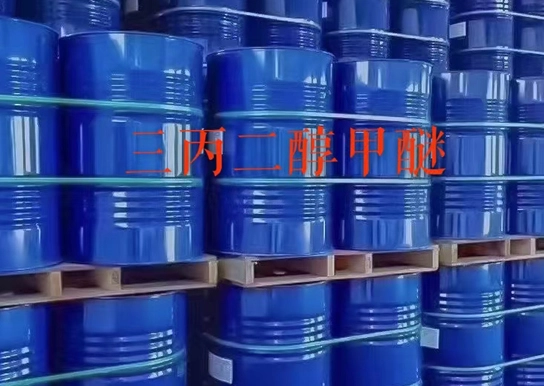
How Supplied of DPNB(Dipropylene Glycol Monomethyl Ether) CAS No. 29911-28-2
REGION | PACKAGING | TRANSPORT MODE |
Europe/Africa | Bulk/Drum | Tank Truck |
LatinAmerica | Bulk/Drum | Tank Truck |
North America | Bulk/Drum | Tank Truck/Tank Car |
Pacific | Bulk/Drum | Tank Truck |
Product Stewardship of DPNB(Dipropylene Glycol Monomethyl Ether) CAS No. 29911-28-2
Dow encourages its customers and potential users to review their applications from the standpoint of human health and environmental aspects. To help ensure that Dow products are not used in ways for which they are not intended or tested, Dow personnel will assist customers in dealing with environmental and product safety considerations. Dow literature, including Material Safety Data Sheets, should be consulted prior to the use.
DPNB (Dipropylene Glycol Monomethyl Ether) – Frequently Asked Questions (FAQ)
Q1: What are the primary functional roles of DPNB in industrial formulations?
A: DPNB functions primarily as a coalescing agent, active solvent, and viscosity modifier—especially valued for its balanced evaporation rate, low volatility, and ability to enhance film formation in water-based coatings and inks.
Q2: Is DPNB compatible with common water-based polymer systems such as acrylics and styrene-acrylic dispersions?
A: Yes, DPNB demonstrates excellent compatibility with a wide range of water-based latexes and emulsions, including acrylic, vinyl acetate, and styrene-acrylic systems, supporting stable formulation without phase separation or haze formation.
Q3: How does DPNB compare to DPMA or DPM in terms of solvent strength and drying profile?
A: Compared to DPMA (dipropylene glycol monomethyl ether acetate), DPNB offers lower ester-based reactivity and milder solvency, while providing a slower, more controllable evaporation rate than DPM (dipropylene glycol methyl ether)—making it particularly suitable for applications requiring extended open time and reduced blushing risk.
Q4: Can DPNB be used in low-VOC or regulatory-compliant formulations?
A: Yes, DPNB is widely utilized in low-VOC product development due to its relatively low vapor pressure and favorable HAPs (Hazardous Air Pollutants) profile, aligning with global efforts to reduce emissions in architectural and industrial coatings.
 English
 Español
 tiếng việt
 русский