English
 Español
 tiếng việt
 русский
High thermal stability with continuous service temperature up to 200 °C.
Excellent compatibility with organic resins, vinyl polymers, and phenolic systems.
Low volatility and minimal outgassing under vacuum or elevated-temperature conditions.
Reactive vinyl groups enable covalent bonding in crosslinking formulations.
Phenyl substitution enhances UV resistance and refractive index versus standard methyl silicone oils.
Reinforcing additive in high-performance silicone rubber compounds.
Functional modifier for heat-resistant coatings and ceramic binder systems.
Viscosity adjuster and release aid in LED encapsulation and optical gels.
Compatibilizer in hybrid organic–inorganic nanocomposites for aerospace sealants.
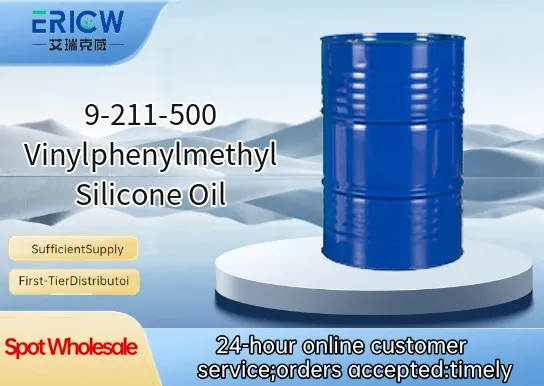
| Chemical Type | Vinylphenylmethyl polysiloxane |
| Product Form | Clear, colorless to pale yellow liquid |
| Appearance | Homogeneous, low-viscosity oil |
| Primary Applications | High-temp elastomers, optical materials, specialty coatings |
| Key Features | Reactive vinyl functionality, phenyl-enhanced thermal/UV stability |
| Benefits | Improved adhesion, reduced migration, enhanced aging resistance |
| Storage Conditions | Store in sealed containers at 15–25 °C, protect from moisture and direct sunlight |
Q1: What distinguishes 9-211-500 from standard methyl silicone oils?
A: 9-211-500 features a vinylphenylmethyl backbone, offering enhanced thermal stability, improved compatibility with aromatic and unsaturated systems, and greater reactivity in hydrosilylation processes compared to conventional dimethyl silicone oils.
Q2: Is this product suitable for use in high-temperature elastomer formulations?
A: Yes — its phenyl and vinyl substituents contribute to superior heat resistance and oxidative stability, making it well-suited for high-temperature vulcanization (HTV) silicone rubber systems and specialty elastomer modifiers.
Q3: Can 9-211-500 be used as a reactive diluent or modifier in addition-cure silicone systems?
A: Yes — the terminal vinyl groups enable participation in platinum-catalyzed hydrosilylation reactions, allowing it to function as a reactive processing aid, viscosity adjuster, or functional modifier in addition-cure formulations.
Q4: How should 9-211-500 be stored to maintain performance integrity?
A: Store in tightly sealed containers under inert atmosphere (e.g., nitrogen), away from moisture, direct sunlight, and elevated temperatures. Prolonged exposure to air or humidity may affect reactivity and viscosity stability over time.
Contact With Us:
E-mail: wangxingqiang@ericwchem.com
Have a Questions? Call Us:
Add:
Building A1, Jiete Industrial Park, Huangpu District, Guangzhou City, Guangdong Province, China