English
 Español
 tiếng việt
 русский
Highly selective hydrogenation catalyst optimized for continuous fixed-bed operation.
Robust thermal and mechanical stability under industrial hydrotreating conditions.
Low nickel leaching and excellent resistance to sulfur poisoning in feedstocks with moderate impurity levels.
Controlled metal dispersion and tailored pore structure for enhanced mass transfer and reduced coking tendency.
Pre-sulfided formulation enabling immediate start-up without on-site sulfidation.
Hydrodeoxygenation (HDO) of bio-based feedstocks including tall oil fatty acid (TOFA) and rosin derivatives.
Selective saturation of unsaturated aldehydes and ketones in fine chemical intermediates.
Refining of renewable diesel (HVO) streams to improve cold flow properties and oxidative stability.
Upgrading of pyrolysis oils derived from lignocellulosic biomass.
Hydrogenation of specialty esters and fatty acid methyl esters (FAME) for high-purity oleochemicals.
| Chemical Type | Nickel-molybdenum on alumina support, pre-sulfided |
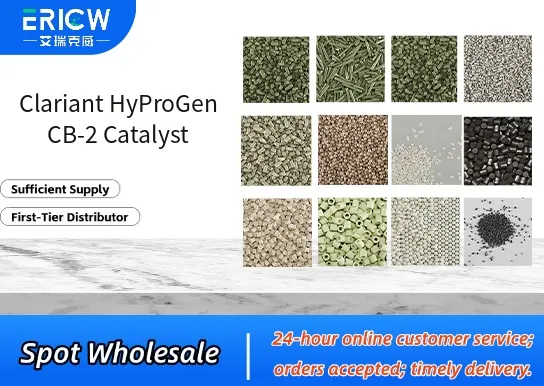
| Product Form | Extrudates (cylindrical, 1.6–1.8 mm diameter) |
| Appearance | Black, free-flowing granular solid |
| Primary Applications | Renewable fuel upgrading, bio-based intermediate hydrogenation |
| Key Features | Fixed-bed compatibility, low-pressure H₂ operation (10–50 bar), wide temperature window (180–320 °C) |
| Benefits | Extended cycle life, reduced catalyst replacement frequency, consistent product quality |
| Storage Requirement | Store in dry, inert atmosphere; avoid exposure to air and moisture |
| Handling Precaution | Use appropriate PPE; handle under nitrogen blanket to prevent pyrophoricity |
Q1: What is the primary function of HyProGen CB-2 in polymer processing?
A: HyProGen CB-2 is a high-performance cobalt-based catalyst designed to promote controlled thermal crosslinking of peroxide-cured elastomers and thermoset polymers, supporting improved scorch safety, consistent cure development, and enhanced final mechanical properties.
Q2: Is HyProGen CB-2 compatible with common peroxide initiators used in rubber compounding?
A: Yes — HyProGen CB-2 is formulated for compatibility with widely used organic peroxides such as dicumyl peroxide (DCP), 2,5-dimethyl-2,5-di(tert-butylperoxy)hexane, and similar high-temperature curing agents in EPDM, NR, and silicone-based systems.
Q3: How should HyProGen CB-2 be incorporated into a rubber compound?
A: It is typically added during the final mixing stage—after carbon black and other fillers but before peroxide—to ensure uniform dispersion and minimize premature catalytic activity. Pre-dispersion in oil or polymer carrier is recommended for optimal handling and distribution.
Q4: Does HyProGen CB-2 require special storage or handling precautions?
A: Yes — it should be stored in a cool, dry place under inert atmosphere or sealed packaging to prevent moisture absorption and oxidation. Avoid prolonged exposure to air and elevated temperatures prior to use, and handle using standard industrial hygiene practices for transition metal compounds.
Q5: Can HyProGen CB-2 be used in food-contact or medical-grade elastomer applications?
A: HyProGen CB-2 is not pre-qualified for direct food-contact or implantable medical applications. Its suitability for regulated end uses must be confirmed through full formulation testing, regulatory review, and compliance verification by the compounder or end-user in accordance with applicable regional requirements.
Contact With Us:
E-mail: wangxingqiang@ericwchem.com
Have a Questions? Call Us:
Add:
Building A1, Jiete Industrial Park, Huangpu District, Guangzhou City, Guangdong Province, China