English
 Español
 tiếng việt
 русский
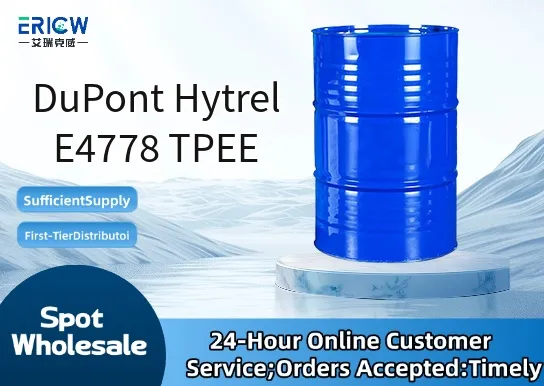
Excellent balance of toughness and flexibility across a wide temperature range (–40 °C to 150 °C short-term)
Outstanding resistance to oils, greases, and many common automotive fluids
Good melt processability for injection molding and extrusion with low moisture sensitivity
High resilience and fatigue resistance for dynamic, repetitive-use components
Enhanced flow characteristics compared to higher-hardness TPEE grades, enabling thin-wall part production
Automotive under-hood air ducts and fluid handling hoses
Powertrain grommets, bushings, and vibration-damping mounts
Industrial pneumatic tubing and connector seals
Consumer appliance components requiring repeated flexing and thermal stability
Medical device housings and ergonomic grips where chemical compatibility is critical
| Chemical Type | Thermoplastic Polyester Elastomer (TPEE) |
| Product Form | Natural-colored pellets |
| Appearance | Opaque, off-white to light tan granules |
| Hardness (Shore D, ASTM D2240) | 48 ± 2 |
| Density (ASTM D792) | 1.16 g/cm³ |
| Melt Flow Rate (230 °C/2.16 kg, ASTM D1238) | 28–36 g/10 min |
| Primary Applications | Dynamic sealing, flexible ducting, vibration isolation |
| Key Features | Oil resistance, thermal stability, high elasticity, processing ease |
Q1: What distinguishes Hytrel E4778 from other TPEE grades in the Hytrel portfolio?
A: Hytrel E4778 is a medium-hardness, high-melt-flow TPEE grade engineered for enhanced processability in thin-wall injection molding and extrusion—particularly where balanced flexibility, resilience, and thermal stability are required. It offers improved flow over higher-durometer grades while retaining superior dynamic fatigue resistance compared to lower-modulus alternatives.
Q2: Is Hytrel E4778 suitable for applications requiring repeated flexing or cyclic loading?
A: Yes—Hytrel E4778 exhibits excellent mechanical recovery and long-term resistance to flex fatigue, making it well-suited for dynamic components such as automotive bellows, power tool grips, and sporting goods hinges where repeated bending or torsional stress occurs.
Q3: Can Hytrel E4778 be overmolded onto common engineering thermoplastics?
A: Yes—it demonstrates good adhesion to substrates like polypropylene (PP), ABS, and polycarbonate (PC) when processed under optimized temperature and mold surface conditions. Bond strength depends on interfacial compatibility, melt temperature control, and part design—adhesion testing is recommended for critical assemblies.
Q4: How does Hytrel E4778 perform under elevated temperature exposure during service?
A: Hytrel E4778 maintains dimensional stability and mechanical integrity at continuous use temperatures up to approximately 120 °C, with short-term peak resistance near 150 °C. Its performance under heat is supported by strong crystalline phase retention and resistance to thermal softening relative to many TPU or TPO alternatives.
Contact With Us:
E-mail: wangxingqiang@ericwchem.com
Have a Questions? Call Us:
Add:
Building A1, Jiete Industrial Park, Huangpu District, Guangzhou City, Guangdong Province, China