English
 Español
 tiếng việt
 русский
High reactivity with standard acrylate monomers for rapid UV curing.
Excellent hardness and scratch resistance in final cured films.
Good flexibility and impact resistance without compromising rigidity.
Low viscosity enables high-solids formulation and easy processing.
Superior weatherability and gloss retention under UV exposure.
UV-curable coatings for plastic substrates (e.g., ABS, PC, PP).
Decorative and protective topcoats for automotive interior trim.
Industrial wood finishes requiring fast line speeds and high durability.
Overprint varnishes for flexible packaging and premium labels.
| Chemical Type | Unsaturated polyester acrylate |
| Product Form | Liquid resin |
| Appearance | Pale yellow to light amber, clear liquid |
| Viscosity (25°C, mPa·s) | 8,000–12,000 |
| Acid Value (mg KOH/g) | < 5 |
| Refractive Index (25°C) | 1.495–1.505 |
| Primary Applications | UV-curable protective & decorative coatings |
| Key Features | Fast cure, high hardness, excellent adhesion to plastics |
Q1: What is the primary application of UVECOAT 3002 in UV-curable systems?
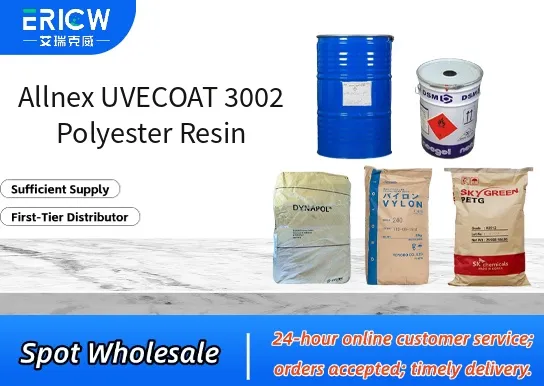
A: UVECOAT 3002 is a low-viscosity, difunctional unsaturated polyester resin designed for use as a reactive diluent and film-forming binder in free-radical UV-curable coatings—particularly where high gloss, good hardness, and excellent adhesion to plastic substrates are required.
Q2: Is UVECOAT 3002 compatible with common photoinitiators used in UV curing?
A: Yes, UVECOAT 3002 exhibits broad compatibility with standard free-radical photoinitiators, including benzophenone derivatives, alpha-hydroxy ketones, and acylphosphine oxides. Optimal initiator selection should be verified experimentally based on substrate, lamp type, and cure speed requirements.
Q3: How does UVECOAT 3002 compare to acrylic-based resins in terms of flexibility and chemical resistance?
A: Compared to many acrylate resins, UVECOAT 3002 offers enhanced flexibility and improved resistance to solvents and alkaline cleaners, while maintaining good crosslink density. Its polyester backbone contributes to superior toughness and impact resistance in thin-film applications.
Q4: Can UVECOAT 3002 be blended with other resins to modify performance?
A: Yes, UVECOAT 3002 is commonly blended with urethane acrylates, epoxy acrylates, or other polyester acrylates to balance properties such as cure speed, surface hardness, flexibility, and substrate adhesion. Compatibility and phase stability should be confirmed through small-scale formulation trials.
Q5: What safety and handling considerations apply to UVECOAT 3002?
A: As with all reactive monomers and oligomers, appropriate personal protective equipment—including nitrile gloves, safety goggles, and adequate ventilation—should be used during handling. Avoid prolonged skin contact and inhalation of mists or vapors. Refer to the current Safety Data Sheet (SDS) for detailed toxicological and first-aid information.
Contact With Us:
E-mail: wangxingqiang@ericwchem.com
Have a Questions? Call Us:
Add:
Building A1, Jiete Industrial Park, Huangpu District, Guangzhou City, Guangdong Province, China