English
 Español
 tiếng việt
 русский
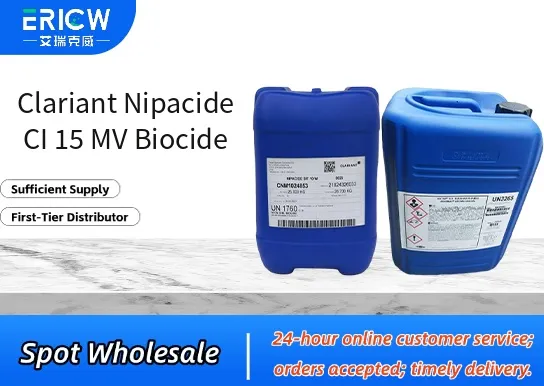
Broad-spectrum antimicrobial activity against bacteria, fungi, and algae.
Stable in high-hardness and high-pH water systems typical of industrial cooling applications.
Low toxicity profile with favorable environmental and handling safety characteristics.
Compatible with common water treatment additives including corrosion inhibitors and scale dispersants.
Effective at low dosage rates, supporting cost-efficient system protection and reduced chemical inventory.
Industrial cooling water systems (open recirculating towers and closed loops).
Process water circuits in paper, pulp, and textile manufacturing.
Oilfield water injection and produced water management systems.
Paints, coatings, and adhesives preservation during storage and application.
Emulsion-based metalworking fluids and hydraulic fluids.
| Chemical Type | Isothiazolinone-based biocide blend |
| Product Form | Liquid concentrate |
| Appearance | Clear to slightly hazy, pale yellow liquid |
| pH (1% aqueous solution) | 3.0 – 5.0 |
| Density (20 °C) | 1.08 – 1.12 g/cm³ |
| Solubility | Completely miscible in water |
| Primary Applications | Cooling water, process water, preservative for water-based formulations |
| Key Features | Broad-spectrum efficacy, oxidative stability, low volatility |
Q1: What is the primary mode of action of Nipacide CI 15 MV Biocide?
A: Nipacide CI 15 MV Biocide functions as a broad-spectrum preservative through controlled release of isothiazolones, which disrupt essential cellular processes in bacteria, yeasts, and molds—particularly effective against Gram-negative microorganisms commonly associated with product spoilage.
Q2: In which types of industrial formulations is Nipacide CI 15 MV Biocide typically used?
A: It is widely applied in water-based industrial products including metalworking fluids, latex paints and coatings, adhesives, construction chemicals, and cleaning concentrates—where long-term microbial stability and compatibility with anionic and nonionic surfactants are required.
Q3: How should Nipacide CI 15 MV Biocide be incorporated into a formulation?
A: It is recommended to add the biocide during the cool-down phase (typically below 40 °C) and after pH adjustment, ensuring thorough mixing. Dosage depends on formulation requirements but generally ranges from 0.1% to 2% by weight, with efficacy optimized when the final product pH remains between 6.0 and 9.5.
Q4: Is Nipacide CI 15 MV Biocide compatible with common thickeners and defoamers?
A: Yes, it demonstrates good compatibility with associative and non-associative thickeners (e.g., HEUR, HEC), silicone and mineral oil-based defoamers, and most standard emulsifiers—though compatibility testing under actual formulation conditions is always advised to confirm performance and stability.
Contact With Us:
E-mail: wangxingqiang@ericwchem.com
Have a Questions? Call Us:
Add:
Building A1, Jiete Industrial Park, Huangpu District, Guangzhou City, Guangdong Province, China