English
 Español
 tiếng việt
 русский
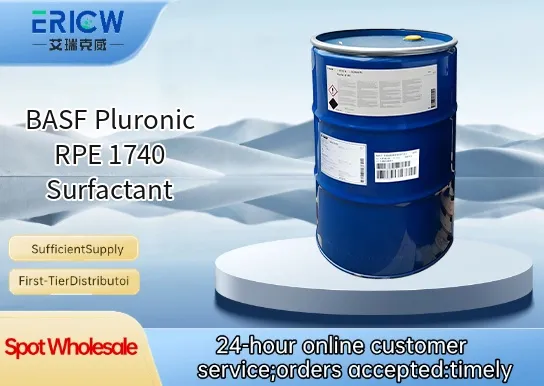
Nonionic triblock copolymer based on poly(ethylene oxide)-poly(propylene oxide)-poly(ethylene oxide) (PEO-PPO-PEO) architecture.
Optimized hydrophilic-lipophilic balance (HLB ~16.5) for effective solubilization and stabilization in aqueous systems.
Low foaming profile suitable for high-shear and recirculating industrial processes.
Excellent thermal and pH stability across broad operating ranges (pH 3–11, up to 80 °C).
Readily biodegradable and compliant with OECD 301B guidelines for environmental safety.
Stabilizer and emulsifier in agrochemical formulations (e.g., SC, SE, and OD concentrates).
Wetting and dispersing agent in pesticide suspension concentrates (SC) and water-dispersible granules (WDG).
Performance additive in industrial cleaning solutions for metalworking and parts washing.
Co-surfactant in personal care emulsions requiring low-irritancy and high mildness profiles.
Viscosity modifier and stabilizer in water-based coatings and architectural paints.
| Chemical Type | Nonionic PEO-PPO-PEO triblock copolymer |
| Product Form | Pale yellow to amber viscous liquid |
| Appearance | Clear to slightly hazy, homogeneous liquid at 25 °C |
| Primary Applications | Agrochemicals, industrial cleaners, coatings, personal care |
| Key Features | Low foaming, high solubilization capacity, thermal/pH stability |
| Benefits | Improved formulation shelf-life, enhanced active ingredient delivery, reduced processing viscosity |
| Recommended Storage | Below 30 °C, protected from direct sunlight and moisture |
| Regulatory Status | REACH registered; compliant with ISO 9001 and ISO 14001 manufacturing standards |
Q1: What is the primary functional role of Pluronic RPE 1740 in formulations?
A: Pluronic RPE 1740 is a nonionic triblock copolymer surfactant designed primarily for emulsification, solubilization, and stabilization of oil-in-water systems. Its balanced hydrophilic-lipophilic character supports performance in demanding applications such as agrochemical concentrates, industrial cleaning blends, and functional coatings.
Q2: Is Pluronic RPE 1740 suitable for use in low-temperature applications?
A: Yes — due to its polypropylene oxide-rich mid-block and moderate ethylene oxide content, Pluronic RPE 1740 exhibits good low-temperature stability and remains effective in formulations operating down to approximately 5 °C without phase separation or significant viscosity increase.
Q3: How does Pluronic RPE 1740 compare to other Pluronic grades in terms of foaming behavior?
A: Pluronic RPE 1740 delivers moderate to low foaming characteristics compared to higher-EO linear grades like L-series, making it well-suited for applications where foam control is critical — such as high-shear industrial cleaning or sprayable agricultural adjuvants.
Q4: Can Pluronic RPE 1740 be used in combination with ionic surfactants?
A: Yes — it is generally compatible with anionic and cationic surfactants when formulated carefully, though synergistic or antagonistic interactions may occur depending on concentration, pH, and electrolyte presence. Compatibility testing under intended use conditions is recommended.
Q5: What are typical dosage guidelines for Pluronic RPE 1740 in emulsion-based products?
A: Dosage depends on formulation requirements and target performance, but it is typically used at low concentrations — generally ranging from 0.1% to 2% by weight — with optimization guided by emulsion stability, droplet size, and interfacial activity testing.
Contact With Us:
E-mail: wangxingqiang@ericwchem.com
Have a Questions? Call Us:
Add:
Building A1, Jiete Industrial Park, Huangpu District, Guangzhou City, Guangdong Province, China