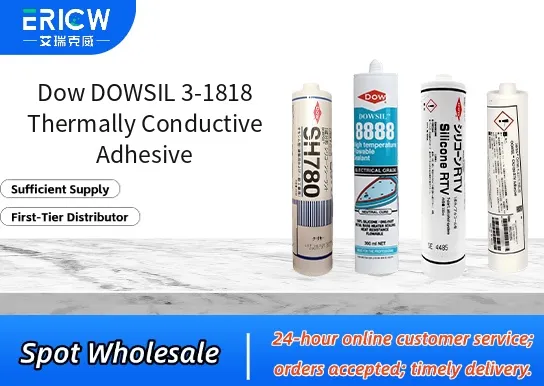
Features Of Dow DOWSIL 3-1818 Thermally Conductive Adhesive
High thermal conductivity for efficient heat dissipation in demanding electronic assemblies.
Room-temperature curing silicone adhesive with excellent long-term stability and reliability.
Low modulus formulation minimizes stress on temperature-sensitive components during thermal cycling.
Electrically insulating to prevent short circuits while maintaining robust thermal performance.
Good adhesion to a wide range of substrates including metals, ceramics, and engineered plastics.
Typical Applications Of Dow DOWSIL 3-1818 Thermally Conductive Adhesive
Attachment of power semiconductors (e.g., IGBTs, MOSFETs) to heat sinks in power electronics.
Bonding LED modules and drivers in high-brightness lighting systems.
Thermal interface bonding in automotive ADAS and infotainment control units.
Die attachment and heat sink bonding in industrial motor drives and inverters.
Thermally conductive structural bonding in renewable energy inverters and battery management systems.
Specifications Of Dow DOWSIL 3-1818 Thermally Conductive Adhesive
| Chemical Type | Room-Temperature Vulcanizing (RTV) Silicone |
| Product Form | Two-component paste (Part A + Part B) |
| Appearance | Off-white, viscous paste |
| Primary Applications | Structural thermal bonding and heat sink attachment |
| Key Features | Electrically insulating, low modulus, thermally conductive |
| Benefits | Reduces thermal resistance, accommodates CTE mismatch, enables simplified assembly |
| Cure Mechanism | Condensation cure at room temperature (accelerated with mild heat) |
| Storage Stability | 12 months unopened at 5–25°C |
Dow DOWSIL 3-1818 Thermally Conductive Adhesive – Frequently Asked Questions (FAQ)
Q1: What are the primary application methods for DOWSIL 3-1818?
A: DOWSIL 3-1818 is typically applied via dispensing systems—including needle dispensing, jetting, or screen printing—depending on part geometry and production requirements. It is formulated for room-temperature cure with optional heat acceleration to improve throughput in high-volume manufacturing.
Q2: Is DOWSIL 3-1818 electrically insulating?
A: Yes, DOWSIL 3-1818 is a non-conductive, thermally conductive adhesive. It provides effective heat transfer between components while maintaining electrical isolation—making it suitable for bonding heat sinks, power modules, and LED assemblies where dielectric integrity is critical.
Q3: How does humidity affect the curing behavior of this adhesive?
A: As a moisture-curing silicone adhesive, DOWSIL 3-1818 relies on ambient atmospheric moisture for crosslinking. Curing speed increases with higher relative humidity and temperature; however, full depth cure in thick sections may require extended time or elevated temperature post-cure to ensure consistent performance across the bond line.
Q4: Can DOWSIL 3-1818 be used for bonding dissimilar substrates such as aluminum, copper, and FR-4 PCBs?
A: Yes, it demonstrates strong adhesion to a wide range of engineering substrates including metals (e.g., aluminum, copper, stainless steel), ceramics, and common printed circuit board materials like FR-4 and polyimide. Surface preparation—such as cleaning and, where appropriate, priming—is recommended to optimize long-term bond reliability under thermal cycling.
 English
 Español
 tiếng việt
 русский