English
 Español
 tiếng việt
 русский
Highly selective for low-temperature transesterification reactions, enabling efficient biodiesel production under mild process conditions.
Thermally stable solid catalyst with extended operational lifetime and minimal leaching in continuous fixed-bed applications.
Non-corrosive and halogen-free formulation, reducing equipment maintenance and simplifying downstream separation.
Consistent batch-to-batch performance validated per Clariant’s ISO 9001-certified manufacturing protocols.
Designed for easy handling and safe storage—non-hygroscopic and stable under ambient warehouse conditions.
Biodiesel production from waste cooking oil and animal fats via continuous-flow transesterification.
Renewable diesel blending component synthesis using fatty acid methyl ester (FAME) upgrading pathways.
Production of bio-based lubricants and specialty esters in fine chemical manufacturing.
Green solvent synthesis where metal-free, high-purity catalysis is required for pharmaceutical intermediates.
On-site decentralized fuel production units operating at <100 °C and low pressure.
| Chemical Type | Heterogeneous solid base catalyst (modified hydrotalcite-derived material) |
| Product Form | Free-flowing granules |
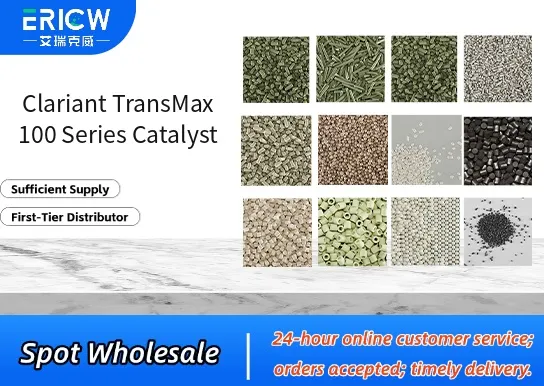
| Appearance | Off-white to light beige cylindrical pellets |
| Primary Applications | Transesterification of triglycerides to FAME; ester interchange reactions |
| Key Features | Non-leaching, thermally robust, regenerable, non-toxic |
| Recommended Operating Temperature Range | 60–95 °C |
| Storage Conditions | Dry, well-ventilated area; avoid prolonged exposure to humidity |
| Handling Precautions | Use standard industrial PPE; avoid inhalation of dust |
Q1: What is the primary function of the TransMax 100 Series in polymer processing?
A: The TransMax 100 Series is a highly efficient transesterification catalyst designed to accelerate ester exchange reactions—particularly in polycondensation and polymer modification processes—enabling improved molecular weight development, enhanced melt stability, and more consistent rheological behavior during extrusion or compounding.
Q2: Is the TransMax 100 Series suitable for use in food-contact or medical-grade polymer applications?
A: While TransMax 100 Series is formulated for high purity and low volatility, its suitability for regulated applications depends on final formulation compliance and regulatory review by the end-user. It is not pre-approved under specific food-contact or medical device regulations; customers must conduct full migration and toxicological assessments as part of their own regulatory submission process.
Q3: How does TransMax 100 compare to traditional tin-based catalysts in terms of thermal stability and processing window?
A: TransMax 100 Series offers significantly improved thermal latency compared to conventional tin catalysts, allowing broader processing windows with reduced risk of premature gelation or discoloration at elevated temperatures. Its controlled reactivity supports longer residence times in extruders without compromising catalytic efficiency.
Q4: What are the recommended handling and storage conditions for TransMax 100 Series?
A: Store in original sealed containers under dry, cool conditions (below 30 °C) and protect from moisture and direct sunlight. Avoid exposure to strong oxidizing agents or incompatible metals. Use appropriate personal protective equipment (PPE), including gloves and eye protection, during handling due to its reactivity in humid environments.
Contact With Us:
E-mail: wangxingqiang@ericwchem.com
Have a Questions? Call Us:
Add:
Building A1, Jiete Industrial Park, Huangpu District, Guangzhou City, Guangdong Province, China