English
 Español
 tiếng việt
 русский
High-performance, addition-cure liquid silicone rubber with excellent thermal stability.
Low compression set and outstanding resilience for long-term sealing performance.
Excellent electrical insulation properties across wide temperature and frequency ranges.
Good adhesion to various substrates including metals, plastics, and glass without primer.
UL 94 V-0 rated for flame retardancy in demanding electronic applications.
Sealing and potting of power electronics and EV battery modules.
Encapsulation of LED lighting components and drivers.
Thermal interface materials (TIM) for heat-sensitive semiconductor assemblies.
Automotive under-hood gasketing and sensor encapsulation.
Medical device housings requiring biocompatibility-compliant silicone solutions.
| Chemical Type | Addition-cure liquid silicone rubber (LSR) |
| Product Form | Two-part system (Part A + Part B) |
| Appearance | Translucent, low-viscosity liquid |
| Shore A Hardness (7 days @ 23°C) | 55 ± 3 |
| Tensile Strength (ASTM D412) | 8.5 MPa |
| Elongation at Break (ASTM D412) | 280 % |
| Volume Resistivity (ASTM D257) | 1.2 × 10¹⁵ Ω·cm |
| UL Recognition | UL 94 V-0, UL 746C, UL 746B |
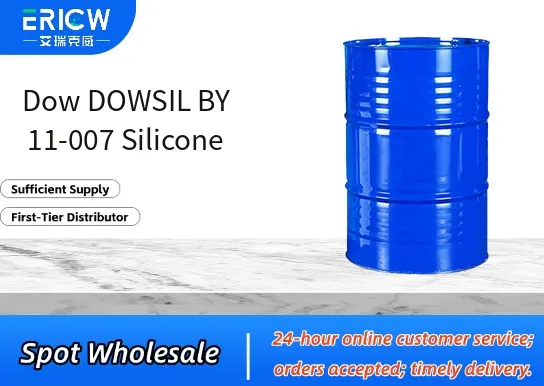
Q1: What is the primary function of DOWSIL BY 11-007 in industrial coatings and inks?
A: DOWSIL BY 11-007 is a silicone-based additive designed to improve substrate wetting, reduce surface defects such as craters and orange peel, and enhance leveling and gloss uniformity in solvent-borne and high-solids coating systems.
Q2: Is DOWSIL BY 11-007 compatible with UV-curable formulations?
A: Yes, it is generally compatible with UV-curable acrylate systems and does not significantly inhibit photopolymerization when used at recommended dosage levels. However, compatibility should be verified in the final formulation due to potential interactions with specific photoinitiators or monomers.
Q3: How should DOWSIL BY 11-007 be incorporated into a formulation?
A: It is typically added during the let-down stage under moderate agitation. Pre-dilution in a compatible solvent may aid dispersion, especially in low-solvent or high-viscosity systems. Avoid high-shear mixing immediately after addition to prevent excessive air entrapment.
Q4: Does DOWSIL BY 11-007 affect recoatability or intercoat adhesion?
A: When used within the recommended dosage range, it generally does not impair intercoat adhesion. However, overuse may lead to surface migration and interfere with subsequent coating layers—formulators are advised to evaluate adhesion performance in their specific system.
Contact With Us:
E-mail: wangxingqiang@ericwchem.com
Have a Questions? Call Us:
Add:
Building A1, Jiete Industrial Park, Huangpu District, Guangzhou City, Guangdong Province, China