English
 Español
 tiếng việt
 русский
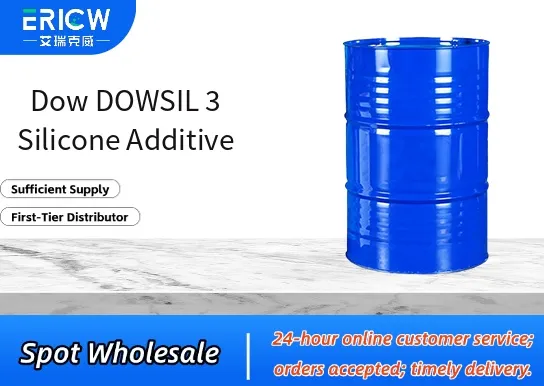
Enhances substrate wetting and leveling in solventborne and high-solids coatings.
Reduces surface defects such as craters, orange peel, and pinholes.
Improves slip and mar resistance without compromising intercoat adhesion.
Compatible with a broad range of resins including acrylics, polyurethanes, and alkyds.
Low dosage requirement—typically effective at 0.05–0.3 wt% in final formulation.
Automotive OEM and refinish coatings.
Industrial maintenance and coil coatings.
Wood and furniture finishes.
Plastic coatings and in-mold release systems.
General-purpose decorative and protective topcoats.
| Chemical Type | Modified polydimethylsiloxane (PDMS) |
| Product Form | Liquid |
| Appearance | Clear, colorless to pale yellow liquid |
| Specific Gravity (25°C) | 0.96–0.99 g/cm³ |
| Viscosity (25°C) | 150–300 mPa·s |
| Solubility | Compatible with common organic solvents; insoluble in water |
| Primary Applications | Surface additive for coating, ink, and adhesive formulations |
| Key Features | Non-reactive, non-foaming, low migration |
Q1: What is the primary function of DOWSIL 3 in coating and ink formulations?
A: DOWSIL 3 is a silicone-based additive designed to improve substrate wetting, reduce surface tension, and enhance leveling and slip properties. It helps minimize defects such as craters, orange peel, and pinholes while contributing to improved mar resistance and surface uniformity.
Q2: Is DOWSIL 3 compatible with waterborne systems?
A: Yes, DOWSIL 3 is formulated for compatibility with both solvent-borne and waterborne coatings, inks, and adhesives. Its hydrophobic silicone structure is stabilized to resist coalescence or destabilization in aqueous environments when properly incorporated during formulation.
Q3: How should DOWSIL 3 be incorporated into a formulation?
A: It is recommended to add DOWSIL 3 during the let-down stage under moderate agitation. Pre-dilution in a compatible solvent or resin solution may aid dispersion. Avoid high-shear mixing post-addition to prevent potential foam generation or over-destruction of surface effects.
Q4: Does DOWSIL 3 affect intercoat adhesion or overcoatability?
A: When used within recommended dosage ranges, DOWSIL 3 typically does not compromise intercoat adhesion. However, excessive use may lead to surface migration and hinder recoatability—formulators are advised to verify adhesion performance in their specific system through application testing.
Q5: Can DOWSIL 3 be used in food-contact compliant coatings?
A: DOWSIL 3 is not intended for direct food-contact applications unless explicitly approved by regulatory authorities and validated in the final formulation. Customers requiring food-contact compliance must conduct full regulatory assessment and obtain formal approval from relevant bodies before use.
Contact With Us:
E-mail: wangxingqiang@ericwchem.com
Have a Questions? Call Us:
Add:
Building A1, Jiete Industrial Park, Huangpu District, Guangzhou City, Guangdong Province, China