English
 Español
 tiếng việt
 русский
Excellent film-forming capability with high gloss and clarity after drying.
Superior flexibility and abrasion resistance for demanding coating applications.
Low VOC content, fully compliant with stringent environmental regulations including EU REACH and China GB/T 38597.
Good compatibility with acrylic emulsions and water-based additives for formulation versatility.
Stable viscosity profile across a wide pH range (6.5–8.5), ensuring reliable processing and storage.
High-performance water-based leather finishing topcoats.
Flexible packaging coatings requiring solvent-free, food-contact-safe formulations.
Textile printing and finishing binders for stretch fabrics and sportswear.
Wood coatings for interior furniture and cabinetry where low odor and rapid dry-through are critical.
Industrial protective coatings for metal substrates in mild-corrosion environments.
| Chemical Type | Anionic aliphatic polyurethane dispersion |
| Product Form | Waterborne liquid dispersion |
| Appearance | Transparent to slightly opalescent, low-viscosity liquid |
| Solids Content | 30 ± 2 wt% |
| pH Value | 7.0–7.8 |
| Viscosity (Brookfield, 25°C, spindle #2, 20 rpm) | 150–400 mPa·s |
| Density (25°C) | 1.02–1.05 g/cm³ |
| Minimum Film Formation Temperature (MFFT) | 15–18°C |
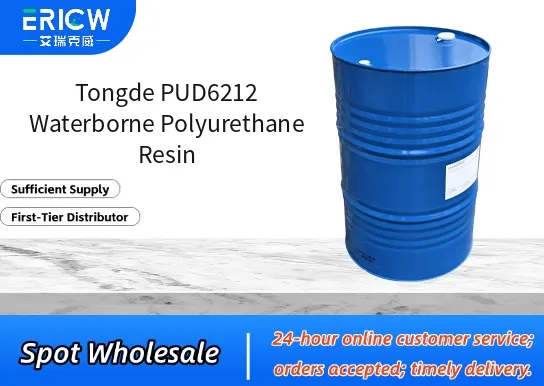
Q1: What are the primary application areas for Tongde PUD6212?
A: Tongde PUD6212 is widely used in water-based leather finishing systems, textile coatings, and flexible packaging laminates where high gloss, excellent abrasion resistance, and good low-temperature flexibility are required. It is also suitable for specialty coatings on synthetic leather and PVC-free decorative films.
Q2: How does PUD6212 perform in terms of film formation and curing behavior?
A: PUD6212 forms clear, continuous films at ambient temperature with good coalescence. It exhibits moderate open time and develops initial mechanical properties rapidly upon water evaporation. Full property development typically occurs within 24–48 hours under standard drying conditions, though thermal acceleration may be applied to enhance crosslink density in industrial settings.
Q3: Is PUD6212 compatible with common water-based additives and pigments?
A: Yes — PUD6212 demonstrates broad compatibility with standard anionic and nonionic surfactants, defoamers, rheology modifiers, and pigment dispersions used in aqueous coating systems. However, strong cationic additives or highly acidic components may destabilize the dispersion and should be evaluated case by case during formulation development.
Q4: Can PUD6212 be blended with other polymer dispersions, such as acrylics or styrene-acrylics?
A: Yes — PUD6212 is generally miscible with many waterborne acrylic and styrene-acrylic dispersions, enabling hybrid systems that balance polyurethane performance (e.g., toughness, elasticity) with acrylic cost-effectiveness and weathering resistance. Compatibility testing is recommended to confirm colloidal stability and film integrity in final blends.
Contact With Us:
E-mail: wangxingqiang@ericwchem.com
Have a Questions? Call Us:
Add:
Building A1, Jiete Industrial Park, Huangpu District, Guangzhou City, Guangdong Province, China