English
 Español
 tiếng việt
 русский
Excellent flexibility and elongation at break for dynamic substrate applications.
Superior adhesion to diverse substrates including metals, plastics, and coated surfaces.
Good chemical resistance against oils, greases, and mild solvents.
Low-temperature curing capability with enhanced pot life for industrial processing.
Low-VOC formulation compliant with current environmental and occupational safety standards.
Automotive interior trim bonding and sealing.
Flexible electronics encapsulation and protective coating.
Industrial gasketing and vibration-damping components.
Medical device assembly requiring biocompatibility-compatible adhesives.
Appliance housing assembly requiring thermal and impact resilience.
| Chemical Type | Aromatic polyurethane prepolymer system |
| Product Form | Two-component liquid resin (Part A: isocyanate-terminated prepolymer; Part B: polyol/hardener blend) |
| Appearance | Amber to light brown transparent liquid (Part A); pale yellow viscous liquid (Part B) |
| Primary Applications | Structural bonding, flexible sealing, and elastomeric coating |
| Key Features | High toughness, low shrinkage, and excellent fatigue resistance |
| Benefits | Extended working time, consistent cure profile, and reduced post-cure stress |
| Storage Conditions | Store at 15–25°C in sealed containers; protect from moisture and direct sunlight |
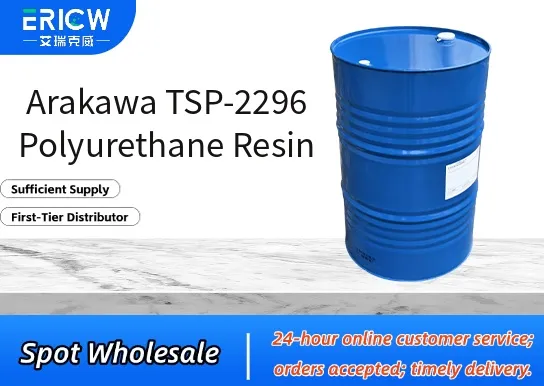
Q1: What is the primary function of TSP-2296 in polyurethane systems?
A: TSP-2296 is a reactive polyurethane resin designed to serve as a crosslinker or chain extender, enhancing film hardness, chemical resistance, and thermal stability in two-component PU coatings and adhesives.
Q2: Is TSP-2296 compatible with both aromatic and aliphatic isocyanate components?
A: Yes, TSP-2296 demonstrates broad compatibility with common aromatic and aliphatic isocyanates, including HDI-based and IPDI-based prepolymers, supporting formulation flexibility for performance-critical applications.
Q3: How does TSP-2296 influence pot life and cure kinetics in 2K PU systems?
A: As a moderately reactive polyol component, TSP-2296 contributes to balanced pot life—typically allowing adequate working time for industrial application—while supporting efficient room-temperature or elevated-temperature curing depending on catalyst selection and NCO:OH ratio.
Q4: Can TSP-2296 be used in solvent-free or high-solids PU formulations?
A: Yes, its low volatility and controlled viscosity make TSP-2296 suitable for solvent-free, high-solids, and even water-dispersible PU systems when appropriately formulated with compatible emulsifiers or reactive diluents.
Contact With Us:
E-mail: wangxingqiang@ericwchem.com
Have a Questions? Call Us:
Add:
Building A1, Jiete Industrial Park, Huangpu District, Guangzhou City, Guangdong Province, China