English
 Español
 tiếng việt
 русский
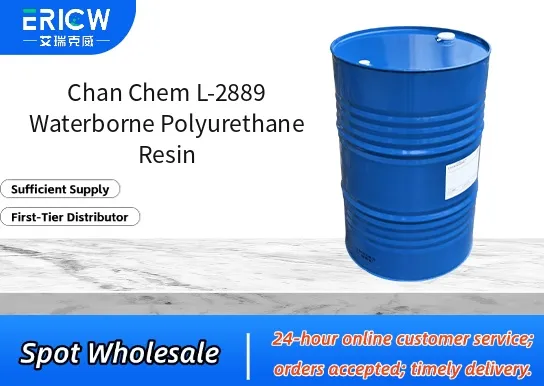
Excellent film-forming capability with high gloss and clarity after drying.
Superior flexibility and abrasion resistance for demanding coating applications.
Low VOC content (< 50 g/L), compliant with stringent environmental regulations.
Good compatibility with acrylic emulsions and water-based additives.
Stable dispersion in water with excellent storage stability (>12 months at 5–35°C).
Water-based leather finishing topcoats.
Flexible packaging coatings for food-contact-safe laminates.
High-performance textile coatings requiring wash-fastness and stretch recovery.
Wood furniture and flooring clear protective topcoats.
Industrial metal primers and clear coats where low odor and fast ambient drying are critical.
| Chemical Type | Aliphatic waterborne polyurethane dispersion |
| Product Form | Opaque white liquid |
| Appearance | Homogeneous milky dispersion, no sedimentation |
| Solids Content | 30 ± 1 wt% |
| pH | 7.5 – 8.5 |
| Viscosity (Brookfield, RVT, #2 spindle, 25°C) | 150 – 400 mPa·s |
| Particle Size (D50) | 80 – 120 nm |
| Minimum Film Formation Temperature (MFFT) | ≤ 10°C |
Q1: What are the primary application areas for Chan Chem L-2889?
A: Chan Chem L-2889 is widely used in waterborne industrial coatings, including flexible packaging laminating adhesives, textile and leather finishing systems, and protective topcoats for wood and plastic substrates where low VOC content and good film-forming properties are required.
Q2: How does L-2889 perform in terms of compatibility with other water-based resins and additives?
A: L-2889 demonstrates good compatibility with common waterborne acrylics, vinyl acetate copolymers, and cellulose derivatives. It also accepts standard anionic and nonionic surfactants, defoamers, and coalescing agents—though compatibility testing under actual formulation conditions is recommended prior to full-scale use.
Q3: Can L-2889 be crosslinked, and what types of crosslinkers are suitable?
A: Yes, L-2889 can be further crosslinked using water-dispersible polyisocyanates or aziridine-based crosslinkers to enhance chemical resistance, heat resistance, and mechanical durability. Crosslinker selection and dosage depend on the desired performance profile and cure conditions.
Q4: Is L-2889 suitable for food-contact applications?
A: L-2889 is formulated without intentionally added heavy metals or formaldehyde-releasing components. While it may be incorporated into food-contact compliant formulations, final regulatory approval depends on the complete system—including all raw materials, processing conditions, and intended use—and must be verified by the formulator against applicable regional requirements.
Contact With Us:
E-mail: wangxingqiang@ericwchem.com
Have a Questions? Call Us:
Add:
Building A1, Jiete Industrial Park, Huangpu District, Guangzhou City, Guangdong Province, China