English
 Español
 tiếng việt
 русский
Excellent film clarity and gloss retention after curing.
Low VOC content (< 50 g/L), compliant with stringent environmental regulations.
Good hydrolytic stability and extended shelf life (≥12 months at 5–30°C).
Superior flexibility and abrasion resistance for demanding coating applications.
Easy coalescence at ambient temperature, enabling low-energy film formation.
High-performance waterborne wood coatings for furniture and flooring.
Industrial maintenance coatings for metal substrates.
Leather finishing topcoats requiring soft hand feel and durability.
Plastic substrate coatings for automotive interior trim and electronics housings.
Eco-friendly textile coatings for technical fabrics and functional apparel.
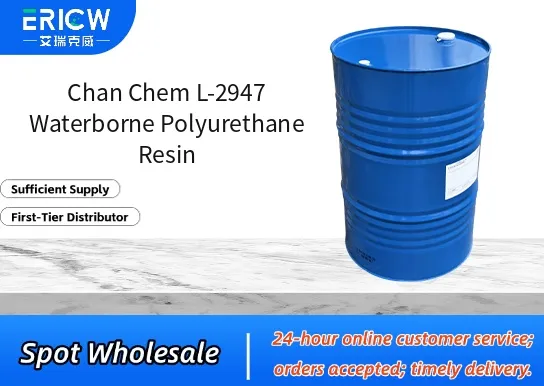
| Chemical Type | Anionic aliphatic polyurethane dispersion |
| Product Form | Aqueous dispersion |
| Appearance | Translucent, slightly bluish milky liquid |
| pH (25°C) | 7.8 – 8.5 |
| Solids Content (wt%) | 30.0 ± 1.0 |
| Viscosity (mPa·s, Brookfield RVT, #2 spindle, 20 rpm, 25°C) | 150 – 400 |
| Particle Size (D50, nm) | 80 – 120 |
| Minimum Film Formation Temperature (MFFT) | ≤ 15°C |
Q1: What are the primary application areas for Chan Chem L-2947?
A: Chan Chem L-2947 is widely used in waterborne industrial coatings, including flexible packaging laminating adhesives, textile finishing systems, and protective topcoats for leather and synthetic fabrics. Its balanced film-forming properties and compatibility with common co-binders make it suitable for high-performance, low-VOC coating formulations.
Q2: Is L-2947 compatible with acrylic emulsions and other common waterborne resins?
A: Yes, L-2947 demonstrates good miscibility with many acrylic, styrene-acrylic, and vinyl acetate-based emulsions. Compatibility should be verified experimentally in the final formulation, as performance may vary depending on pH, ionic strength, and shear history during mixing.
Q3: How does L-2947 perform in terms of film hardness and flexibility?
A: L-2947 forms films with a favorable balance of toughness, elasticity, and moderate surface hardness. It delivers excellent abrasion resistance and low-temperature flexibility without requiring high levels of external plasticizers, supporting durable performance across varying service conditions.
Q4: Can L-2947 be crosslinked to enhance chemical resistance or heat stability?
A: Yes, L-2947 contains reactive functional groups that allow for post-crosslinking using water-dispersible aziridines, carbodiimides, or polyisocyanates. Crosslink density and final properties depend on the choice and dosage of crosslinker, as well as curing conditions such as temperature and dwell time.
Contact With Us:
E-mail: wangxingqiang@ericwchem.com
Have a Questions? Call Us:
Add:
Building A1, Jiete Industrial Park, Huangpu District, Guangzhou City, Guangdong Province, China