English
 Español
 tiếng việt
 русский
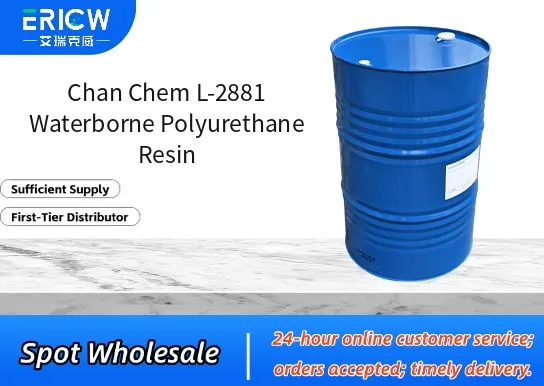
Low-VOC, environmentally compliant formulation meeting global regulatory standards for waterborne coatings.
Excellent film flexibility and elongation, ensuring crack resistance on dynamic or thermally cycled substrates.
Superior adhesion to diverse substrates including plastics (PVC, ABS), metals, and treated wood without primer.
Good hydrolytic stability and storage shelf life (>12 months at 5–30°C in sealed containers).
Easy incorporation with common water-based acrylics and crosslinkers for hybrid system optimization.
High-performance waterborne topcoats for automotive interior trim and instrument panels.
Flexible protective coatings for synthetic leather and textile laminates in footwear and upholstery.
Durable clearcoats for wood furniture and architectural millwork requiring low-yellowing aesthetics.
Functional binder in water-based overprint varnishes for flexible packaging films.
Base resin for eco-friendly industrial maintenance coatings on metal and plastic components.
| Chemical Type | Anionic aliphatic polyurethane dispersion |
| Product Form | Opaque white to slightly bluish liquid |
| Appearance | Homogeneous aqueous dispersion |
| Solids Content (wt%) | 30.0 ± 1.0% |
| pH (at 25°C) | 7.8 – 8.5 |
| Viscosity (mPa·s, Brookfield RVT, #2 spindle, 20 rpm) | 150 – 400 |
| Particle Size (D50, nm) | 80 – 120 |
| Minimum Film Formation Temperature (MFFT) | ≤ 15°C |
Q1: What are the primary application areas for Chan Chem L-2881?
A: Chan Chem L-2881 is widely used in water-based coatings and inks for flexible packaging, textile finishing, leather topcoats, and industrial wood coatings—where high film flexibility, abrasion resistance, and low-VOC performance are required.
Q2: Is L-2881 compatible with common waterborne acrylic or epoxy dispersions?
A: Yes, L-2881 demonstrates good compatibility with many waterborne acrylic emulsions and epoxy dispersions, enabling hybrid formulations that balance hardness, elasticity, and chemical resistance. Compatibility testing under specific formulation conditions is recommended prior to full-scale use.
Q3: How should L-2881 be stored and handled to maintain stability?
A: Store in tightly sealed containers at temperatures between 5°C and 35°C, away from freezing and prolonged exposure to direct sunlight. Avoid contamination with strong acids, bases, or incompatible solvents. Stir gently before use if phase separation occurs after extended storage.
Q4: Does L-2881 require a coalescing agent or catalyst for film formation?
A: Film formation typically occurs via ambient coalescence without added catalysts. However, coalescing agents may be beneficial in low-temperature or high-humidity curing environments to ensure complete particle fusion and optimal film integrity.
Contact With Us:
E-mail: wangxingqiang@ericwchem.com
Have a Questions? Call Us:
Add:
Building A1, Jiete Industrial Park, Huangpu District, Guangzhou City, Guangdong Province, China