English
 Español
 tiếng việt
 русский
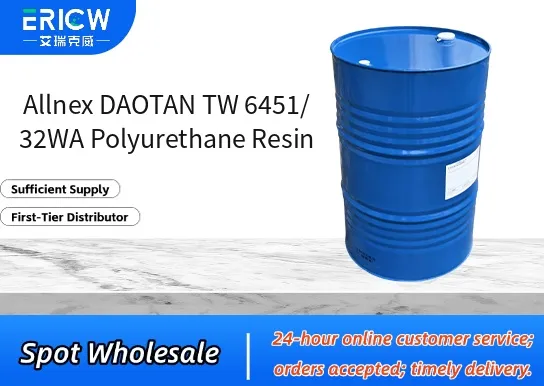
High-performance aliphatic polyurethane dispersion offering excellent UV resistance and long-term gloss retention.
Low-VOC, waterborne formulation compliant with stringent environmental and regulatory requirements (e.g., EU REACH, US EPA).
Superior flexibility and impact resistance at ambient and low temperatures.
Excellent compatibility with acrylics, cellulose derivatives, and common co-binders for hybrid systems.
Good hydrolytic stability and freeze-thaw resistance for reliable storage and handling.
High-end architectural coatings requiring weatherability and color stability.
Industrial maintenance coatings for metal and concrete substrates.
Wood coatings where clarity, hardness, and scratch resistance are critical.
Plastic coatings for automotive interior trim and consumer electronics.
Leather finishing topcoats demanding soft touch and abrasion resistance.
| Chemical Type | Aliphatic polyurethane dispersion |
| Product Form | Waterborne liquid dispersion |
| Appearance | Opaque white to slightly bluish translucent liquid |
| Non-Volatile Content (wt%) | 32 ± 1 % |
| pH | 7.5 – 8.5 |
| Viscosity (mPa·s, 23°C, Brookfield RVT, spindle #2, 20 rpm) | 150 – 400 |
| Density (g/cm³, 23°C) | 1.02 – 1.05 |
| Freeze-Thaw Stability | Passed (3 cycles: –18°C × 16 h / 23°C × 8 h) |
Q1: What is the primary function of DAOTAN TW 6451/32WA in polyurethane coating systems?
A: DAOTAN TW 6451/32WA is a waterborne polyurethane dispersion designed to serve as a reactive coalescing agent and film-forming aid, enhancing low-temperature film formation, improving mechanical properties, and contributing to improved scratch and abrasion resistance in final coatings.
Q2: Is DAOTAN TW 6451/32WA compatible with common waterborne acrylic and hybrid polyurethane-acrylic systems?
A: Yes, it demonstrates good compatibility with a broad range of waterborne acrylic dispersions, styrene-acrylic copolymers, and hybrid PU-acrylic systems, enabling formulation flexibility for architectural, industrial, and wood coatings without significant risk of destabilization or phase separation.
Q3: How should DAOTAN TW 6451/32WA be incorporated into a waterborne formulation?
A: It is typically added during the let-down stage, after neutralization and under gentle agitation, to avoid excessive shear or premature viscosity changes. Pre-dilution with a portion of the formulation’s water phase may facilitate uniform dispersion, especially in high-solids or viscous systems.
Q4: Does DAOTAN TW 6451/32WA contribute to VOC reduction in finished coatings?
A: Yes — as a waterborne polyurethane resin, it replaces traditional solvent-based film formers and coalescents, supporting formulations that meet stringent VOC regulations and sustainability targets without compromising film integrity or performance.
Contact With Us:
E-mail: wangxingqiang@ericwchem.com
Have a Questions? Call Us:
Add:
Building A1, Jiete Industrial Park, Huangpu District, Guangzhou City, Guangdong Province, China