English
 Español
 tiếng việt
 русский
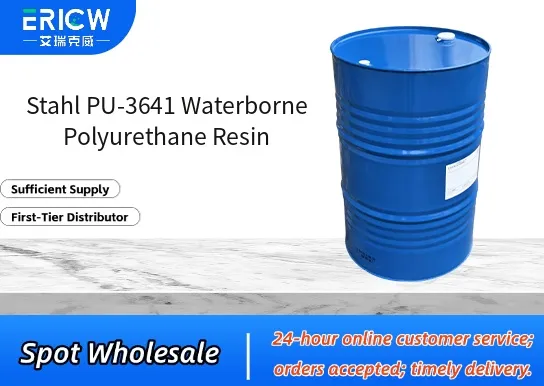
Low-VOC, environmentally compliant formulation meeting stringent global regulatory requirements.
Excellent film-forming properties with high gloss retention and superior clarity.
Outstanding flexibility and abrasion resistance on flexible substrates.
Good compatibility with acrylics, cellulose derivatives, and common waterborne additives.
Stable dispersion with broad pH tolerance (pH 7.5–9.0) and low sensitivity to freezing.
Topcoats for synthetic leather (e.g., PU-coated polyester or nylon fabrics).
Finishing systems for automotive interior trim and soft-touch surfaces.
Functional coatings for technical textiles requiring breathability and durability.
Base formulations for eco-friendly furniture and upholstery protective finishes.
Blending component in waterborne leather finishing systems for improved handle and scuff resistance.
| Chemical Type | Aliphatic polyurethane dispersion |
| Product Form | Waterborne anionic dispersion |
| Appearance | Translucent, slightly bluish liquid |
| Solids Content | 35.0 ± 1.0 wt% |
| pH (25°C) | 8.2 ± 0.3 |
| Viscosity (Brookfield, LVT, #3 spindle, 20 rpm, 25°C) | 150–300 mPa·s |
| Particle Size (D50) | Approx. 80–120 nm |
| Minimum Film Formation Temperature (MFFT) | ≈ 15°C |
Q1: What are the primary application areas for Stahl PU-3641?
A: Stahl PU-3641 is widely used in high-performance waterborne coatings and finishes for leather, textiles, and synthetic materials—particularly where flexibility, abrasion resistance, and low-VOC processing are required. It is commonly incorporated into topcoats, binders, and film-forming layers for automotive interiors, footwear, and upholstery.
Q2: How does Stahl PU-3641 compare to solvent-based polyurethane resins in terms of film properties?
A: Stahl PU-3641 delivers film performance—including tensile strength, elongation, and hydrolytic stability—that approaches that of many conventional solvent-based systems, while enabling significantly lower VOC emissions and improved workplace safety. Its waterborne nature may require slight adjustments to drying conditions and formulation compatibility, but final films retain excellent clarity, softness, and adhesion on diverse substrates.
Q3: Is Stahl PU-3641 compatible with common crosslinkers and additives used in finishing formulations?
A: Yes, Stahl PU-3641 is formulated to be compatible with a range of water-dispersible crosslinkers (e.g., aziridine, carbodiimide, or blocked isocyanate types), as well as standard rheology modifiers, defoamers, and wetting agents. Compatibility should always be verified in the final formulation due to potential interactions with pH-sensitive or ionic additives.
Q4: What are the recommended storage and handling conditions?
A: Store Stahl PU-3641 in tightly sealed containers at temperatures between 5 °C and 30 °C, away from direct sunlight and freezing conditions. Prolonged exposure to temperatures below 5 °C may cause irreversible viscosity changes or phase separation. Prior to use, allow the product to equilibrate to ambient temperature and stir gently to ensure homogeneity.
Contact With Us:
E-mail: wangxingqiang@ericwchem.com
Have a Questions? Call Us:
Add:
Building A1, Jiete Industrial Park, Huangpu District, Guangzhou City, Guangdong Province, China