English
 Español
 tiếng việt
 русский
High solids content for reduced VOC emissions and improved application efficiency.
Excellent compatibility with acrylic and polyester resins in hybrid coating systems.
Superior flexibility and impact resistance without compromising chemical durability.
Good flow and leveling properties for smooth, high-gloss finishes.
Designed for ambient- or low-bake curing, supporting energy-efficient manufacturing processes.
Automotive OEM clearcoats and refinish topcoats.
Industrial maintenance coatings for metal substrates.
General-purpose protective coatings for agricultural and construction equipment.
High-performance coil coatings requiring excellent formability and weather resistance.
Architectural metal façade and cladding systems.
| Chemical Type | Aliphatic polyisocyanate-based polyurethane resin (blocked isocyanate) |
| Product Form | Liquid |
| Appearance | Clear to slightly yellow viscous liquid |
| Primary Applications | Two-component (2K) polyurethane topcoats and industrial protective coatings |
| Key Features | Low viscosity, high reactivity upon thermal activation, excellent UV stability |
| Benefits | Enhanced film hardness development, extended pot life at ambient temperature, minimal yellowing |
| Solvent System | Standard aromatic and aliphatic hydrocarbon-compatible |
| Storage Stability | ≥12 months at 20–25°C in sealed original container |
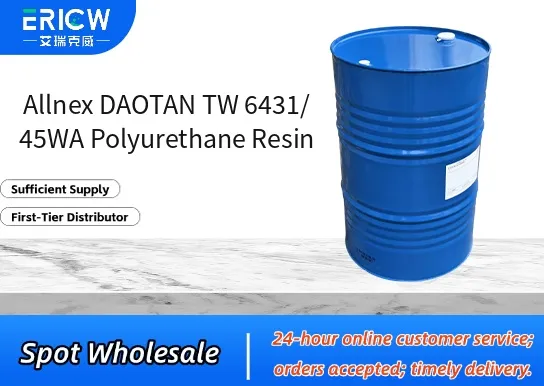
Q1: What is the primary function of DAOTAN TW 6431/45WA in polyurethane systems?
A: DAOTAN TW 6431/45WA is a waterborne polyurethane dispersion designed to serve as a film-forming binder or performance modifier—enhancing flexibility, abrasion resistance, and adhesion in coatings, inks, and sealants without requiring organic solvents.
Q2: Is DAOTAN TW 6431/45WA compatible with common water-based acrylic or polyester dispersions?
A: Yes, it demonstrates good compatibility with many standard waterborne acrylics and polyester dispersions, enabling hybrid formulations. However, compatibility should be verified experimentally under specific pH, ionic strength, and shear conditions relevant to the end-use system.
Q3: How does DAOTAN TW 6431/45WA behave during ambient and forced drying?
A: It forms continuous, cohesive films at room temperature but benefits from moderate thermal curing (e.g., 60–80 °C) to optimize crosslink density, hardness development, and chemical resistance—particularly in high-performance industrial applications.
Q4: Can this resin be used in direct food-contact coatings?
A: DAOTAN TW 6431/45WA is not pre-qualified for direct food contact. Formulators intending such use must conduct full regulatory assessment—including migration testing and compliance verification against applicable regional regulations—based on the final cured coating composition and application conditions.
Contact With Us:
E-mail: wangxingqiang@ericwchem.com
Have a Questions? Call Us:
Add:
Building A1, Jiete Industrial Park, Huangpu District, Guangzhou City, Guangdong Province, China