English
 Español
 tiếng việt
 русский
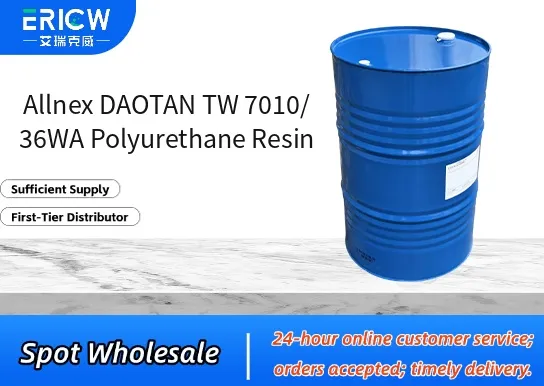
Waterborne aliphatic polyurethane dispersion offering excellent UV resistance and long-term gloss retention.
Low VOC formulation compliant with stringent global environmental regulations including EU REACH and US EPA standards.
Good film-forming properties with balanced hardness, flexibility, and abrasion resistance.
Compatible with common waterborne acrylics and crosslinkers for hybrid system optimization.
Stable viscosity profile over time, enabling consistent processing in industrial coating lines.
High-performance wood coatings for furniture and interior joinery.
Industrial maintenance coatings for metal substrates requiring weatherability.
Waterborne topcoats for plastic and composite surfaces in automotive interiors.
Eco-friendly floor coatings for commercial and residential applications.
Clear protective finishes for decorative laminates and engineered wood panels.
| Chemical Type | Aliphatic waterborne polyurethane dispersion |
| Product Form | Ready-to-use liquid dispersion |
| Appearance | Opaque white to slightly bluish milky liquid |
| pH (at 25°C) | 8.0 – 8.8 |
| Solids Content (wt%) | 36 ± 1% |
| Viscosity (mPa·s, Brookfield RVT, spindle #3, 20 rpm) | 150 – 400 |
| Density (g/cm³ at 25°C) | 1.02 – 1.05 |
| Storage Stability | ≥6 months at 5–30°C in sealed container |
Q1: What is the primary function of DAOTAN TW 7010/36WA in polyurethane coatings?
A: DAOTAN TW 7010/36WA is a waterborne polyurethane dispersion designed to enhance film formation, flexibility, and mechanical durability in high-performance topcoats—particularly where low-VOC compliance and good substrate adhesion are required.
Q2: Is DAOTAN TW 7010/36WA compatible with common crosslinkers used in industrial PU systems?
A: Yes, it demonstrates good compatibility with standard aliphatic isocyanate crosslinkers, including blocked and water-dispersible types. Compatibility testing under specific formulation conditions is recommended prior to full-scale use.
Q3: How does DAOTAN TW 7010/36WA perform in terms of chemical resistance and abrasion resistance?
A: Films based on this resin typically exhibit good resistance to water, mild alkalis, and common cleaning agents, along with enhanced resistance to mechanical wear—making it suitable for demanding interior architectural and furniture coating applications.
Q4: Can DAOTAN TW 7010/36WA be blended with acrylic dispersions or other polymer emulsions?
A: It is generally compatible with many acrylic dispersions and styrene-acrylic emulsions, enabling hybrid formulations that balance cost, performance, and regulatory requirements. Stability and film integrity should be verified through lab-scale blending trials.
Contact With Us:
E-mail: wangxingqiang@ericwchem.com
Have a Questions? Call Us:
Add:
Building A1, Jiete Industrial Park, Huangpu District, Guangzhou City, Guangdong Province, China