English
 Español
 tiếng việt
 русский
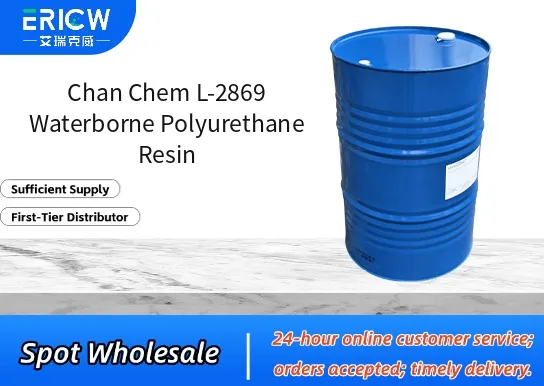
Excellent film-forming capability with high gloss and clarity after drying.
Superior flexibility and abrasion resistance for demanding coating applications.
Low VOC content (< 50 g/L), compliant with stringent environmental regulations.
Good water resistance and chemical resistance to mild alkalis and aliphatic solvents.
Easy integration with acrylic emulsions and other waterborne systems for hybrid formulations.
Waterborne wood coatings for furniture and flooring finishes.
Leather finishing topcoats requiring soft hand feel and scuff resistance.
Plastic substrates coating, including ABS and PC, for decorative and protective layers.
Industrial maintenance coatings for metal components in low-VOC environments.
Overprint varnishes for flexible packaging films and paperboard.
| Chemical Type | Aliphatic waterborne polyurethane dispersion |
| Product Form | Opaque white to slightly yellow liquid |
| Appearance | Homogeneous aqueous dispersion |
| Solids Content (wt%) | 28–32% |
| pH | 7.5–8.5 |
| Viscosity (Brookfield, #2 spindle, 20 rpm, 25°C) | 100–300 mPa·s |
| Particle Size (D50) | 80–120 nm |
| Minimum Film-Forming Temperature (MFFT) | 15–20°C |
Q1: What are the primary application areas for Chan Chem L-2869?
A: Chan Chem L-2869 is widely used in high-performance waterborne coatings for flexible substrates, including synthetic leather finishing, textile coatings, and soft-touch industrial finishes where durability, flexibility, and low-VOC compliance are critical.
Q2: Is L-2869 compatible with common waterborne acrylic or polyester dispersions?
A: Yes, L-2869 exhibits good compatibility with many standard waterborne acrylics, vinyl acetate copolymers, and polyester dispersions, enabling formulators to build hybrid systems with balanced hardness, elongation, and film integrity.
Q3: How should L-2869 be stored and handled to maintain stability?
A: Store in tightly sealed containers at temperatures between 5 °C and 30 °C, away from freezing conditions and direct sunlight. Avoid prolonged exposure to high humidity during handling, and always ensure equipment is clean and free of incompatible solvents or contaminants before use.
Q4: Does L-2869 require a catalyst or coalescent for film formation?
A: L-2869 is designed to form continuous films under ambient drying conditions without mandatory catalysis; however, coalescents may be added selectively—depending on substrate, ambient temperature, and desired film development speed—to optimize early-stage film integrity and final mechanical properties.
Q5: Can L-2869 be crosslinked to enhance chemical resistance?
A: Yes, L-2869 contains reactive functional groups that allow post-crosslinking using water-dispersible aziridines, carbodiimides, or polyisocyanates, enabling significant improvements in solvent resistance, abrasion performance, and wet adhesion when required by end-use specifications.
Contact With Us:
E-mail: wangxingqiang@ericwchem.com
Have a Questions? Call Us:
Add:
Building A1, Jiete Industrial Park, Huangpu District, Guangzhou City, Guangdong Province, China