English
 Español
 tiếng việt
 русский
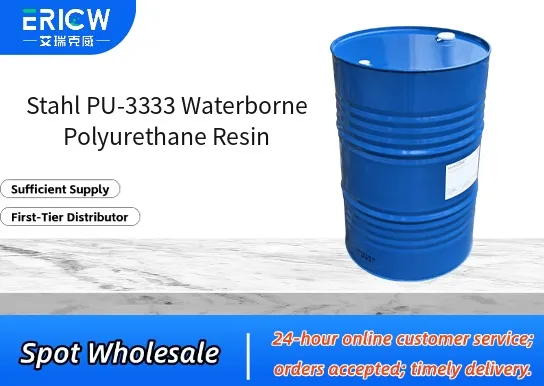
Low-VOC, environmentally compliant formulation meeting stringent global regulatory requirements.
Excellent film-forming capability with high gloss retention and clarity after drying.
Superior abrasion resistance and flexibility for demanding coating applications.
Good compatibility with common waterborne acrylics and crosslinkers for hybrid systems.
Stable dispersion with low viscosity, enabling easy handling and spray application.
Waterborne topcoats for automotive interior trim and dashboards.
High-performance coatings for synthetic leather (PVC/PU substrates).
Protective clear coats for wood furniture and MDF panels.
Functional finishes for technical textiles requiring durability and breathability.
Basecoat/clearcoat systems in industrial plastic coating applications.
| Chemical Type | Aliphatic polyurethane dispersion |
| Product Form | Aqueous dispersion |
| Appearance | Translucent, slightly bluish liquid |
| Solids Content | 30–32 wt% (at 110°C, 15 min) |
| pH | 7.8–8.4 |
| Viscosity (25°C) | 150–300 mPa·s (Brookfield RVT, spindle #3, 12 rpm) |
| Density (20°C) | 1.01–1.03 g/cm³ |
| Minimum Film Formation Temperature (MFFT) | ≈12°C |
Q1: What are the primary application areas for Stahl PU-3333?
A: Stahl PU-3333 is widely used in high-performance waterborne leather finishing systems, particularly for topcoats and semi-transparent effect layers where excellent film integrity, flexibility, and resistance to abrasion and yellowing are required.
Q2: Can Stahl PU-3333 be blended with other resins or additives?
A: Yes, it exhibits good compatibility with common waterborne acrylics, polyurethanes, and crosslinkers used in leather coatings. Compatibility testing under actual formulation conditions is recommended before full-scale integration.
Q3: What is the typical solids content and viscosity range of Stahl PU-3333?
A: It is supplied as a stable aqueous dispersion with solids content in the range of 30–35% w/w and low-to-moderate viscosity, enabling easy handling and incorporation into standard coating formulations without excessive dilution or high-shear mixing.
Q4: Does Stahl PU-3333 require post-crosslinking for optimal performance?
A: While it forms cohesive films upon drying, enhanced chemical resistance and durability are typically achieved when used with compatible ambient-cure or heat-activated crosslinkers—especially in demanding end-use applications.
Q5: How should Stahl PU-3333 be stored to maintain stability?
A: Store in original sealed containers at temperatures between 5 °C and 30 °C, avoiding freezing and prolonged exposure to direct sunlight or excessive heat, which may affect colloidal stability over time.
Contact With Us:
E-mail: wangxingqiang@ericwchem.com
Have a Questions? Call Us:
Add:
Building A1, Jiete Industrial Park, Huangpu District, Guangzhou City, Guangdong Province, China