English
 Español
 tiếng việt
 русский
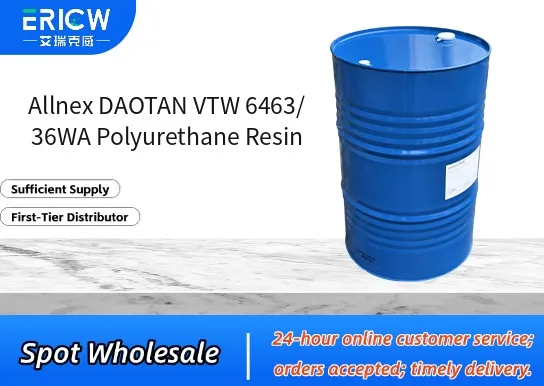
Waterborne aliphatic polyurethane dispersion offering excellent UV resistance and long-term gloss retention.
Low VOC formulation compliant with stringent global environmental regulations including EU Ecolabel and US EPA standards.
Outstanding chemical resistance to household cleaners, mild acids, and alkalis without compromising film integrity.
Excellent mechanical properties including high abrasion resistance and flexibility for demanding coating applications.
Good compatibility with acrylic co-resins and crosslinkers, enabling formulation versatility for hybrid systems.
High-performance waterborne wood coatings for interior furniture and flooring.
Premium architectural coatings requiring durability and aesthetic clarity on trim and cabinetry.
Industrial maintenance coatings for metal substrates in light-duty indoor environments.
UV-curable hybrid topcoats where waterborne PU provides base-layer toughness and adhesion.
Specialty coatings for medical device housings requiring biocompatibility-supporting formulations.
| Chemical Type | Aliphatic waterborne polyurethane dispersion |
| Product Form | Liquid dispersion |
| Appearance | Opaque white to slightly bluish liquid |
| Solids Content (wt%) | 36 ± 1% |
| pH | 8.0 – 8.8 |
| Viscosity (mPa·s, Brookfield RVT, #2 spindle, 20 rpm, 25°C) | 150 – 400 |
| Density (g/cm³, 25°C) | 1.02 – 1.05 |
| Minimum Film Formation Temperature (MFFT) | ≤ 15°C |
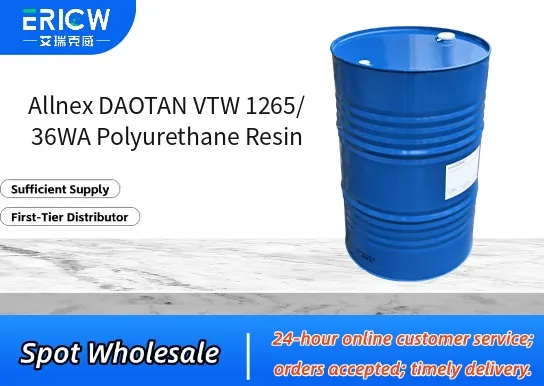
Q1: What is the primary function of DAOTAN VTW 1265/36WA in polyurethane coatings?
A: DAOTAN VTW 1265/36WA is a water-dispersible polyurethane resin designed to serve as a film-forming binder or co-binder in high-performance waterborne PU systems, contributing to enhanced flexibility, abrasion resistance, and substrate adhesion without compromising environmental compliance.
Q2: Is DAOTAN VTW 1265/36WA compatible with common waterborne acrylic dispersions?
A: Yes — it is formulated for good compatibility with a broad range of waterborne acrylics, vinyl acetate copolymers, and other anionic or non-ionic dispersions, enabling hybrid formulations that balance cost, performance, and regulatory requirements.
Q3: How should DAOTAN VTW 1265/36WA be incorporated into a coating formulation?
A: It is typically added during the let-down stage under gentle agitation, after pigments and thickeners have been dispersed. Avoid high-shear mixing post-addition to preserve particle integrity and colloidal stability.
Q4: Does this resin require a crosslinker for optimal performance?
A: While it delivers good single-component film properties, performance attributes such as chemical resistance, hardness development, and thermal stability are significantly enhanced when used with suitable water-dispersible polyisocyanate crosslinkers — especially in demanding industrial or automotive refinish applications.
Contact With Us:
E-mail: wangxingqiang@ericwchem.com
Have a Questions? Call Us:
Add:
Building A1, Jiete Industrial Park, Huangpu District, Guangzhou City, Guangdong Province, China