English
 Español
 tiếng việt
 русский
Low-VOC, environmentally compliant formulation meeting stringent global regulatory requirements.
Excellent film-forming capability with balanced hardness and flexibility at ambient cure conditions.
Superior water resistance and chemical resistance to weak acids and alkaline solutions.
Good compatibility with acrylic dispersions and other waterborne resins for hybrid systems.
Stable storage performance with shelf life exceeding 12 months under recommended conditions.
Waterborne industrial wood coatings for furniture and cabinetry.
High-performance coatings for metal substrates in architectural and appliance applications.
Topcoats and clear finishes for plastic substrates including ABS and PC.
Basecoat/clearcoat systems requiring low-temperature crosslinking and high gloss retention.
Coatings for flexible packaging laminates where solvent-free processing is required.
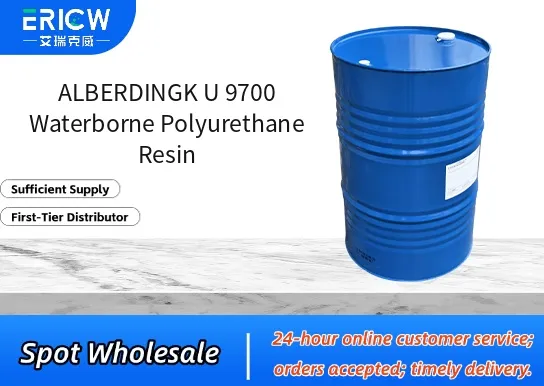
| Chemical Type | Anionic aliphatic polyurethane dispersion |
| Product Form | Opaque white liquid |
| Appearance | Homogeneous aqueous dispersion |
| Solids Content (wt. %) | 30–32% |
| pH Value | 7.5–8.5 |
| Viscosity (mPa·s, 25°C, Brookfield RVT, spindle #3, 6 rpm) | 1,500–3,500 |
| Density (g/cm³, 20°C) | 1.02–1.05 |
| Minimum Film Formation Temperature (MFFT) | ~15°C |
Q1: What is the primary application area for ALBERDINGK U 9700?
A: ALBERDINGK U 9700 is primarily designed for high-performance waterborne coatings and inks requiring excellent film integrity, flexibility, and chemical resistance — especially in industrial wood, plastic, and metal finishing applications where low VOC content and good substrate adhesion are critical.
Q2: Is ALBERDINGK U 9700 compatible with common waterborne acrylic or epoxy dispersions?
A: Yes, ALBERDINGK U 9700 exhibits good compatibility with many standard waterborne acrylic dispersions and certain modified epoxy emulsions. Compatibility should be verified empirically in the final formulation, as performance may vary depending on pH, ionic strength, and surfactant systems used.
Q3: How does ALBERDINGK U 9700 contribute to film formation and mechanical properties?
A: As a self-crosslinking waterborne polyurethane resin, U 9700 enhances film cohesion, tensile strength, and abrasion resistance without requiring external crosslinkers. It forms continuous, resilient films upon coalescence and ambient or mild thermal curing, delivering improved scratch resistance and elasticity compared to conventional acrylic dispersions.
Q4: Can ALBERDINGK U 9700 be used in formulations targeting food-contact compliant coatings?
A: ALBERDINGK U 9700 is not pre-certified for direct food contact. Its suitability for such applications depends entirely on the full formulation, processing conditions, and compliance verification against applicable regional regulations — end users must conduct thorough migration testing and regulatory assessment before claiming food-contact compliance.
Contact With Us:
E-mail: wangxingqiang@ericwchem.com
Have a Questions? Call Us:
Add:
Building A1, Jiete Industrial Park, Huangpu District, Guangzhou City, Guangdong Province, China