English
 Español
 tiếng việt
 русский
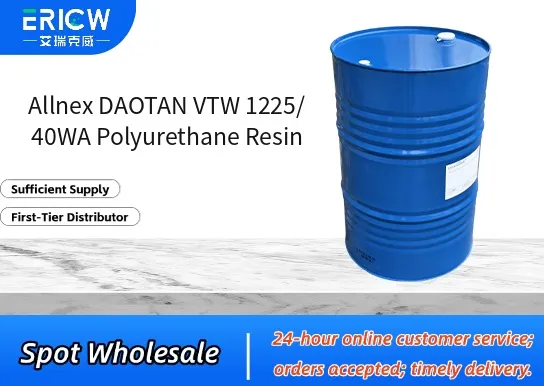
Waterborne aliphatic polyurethane dispersion offering excellent UV resistance and gloss retention.
Low VOC formulation compliant with stringent environmental regulations including EU REACH and US EPA standards.
Good hydrolytic stability and compatibility with common acrylic and polyester co-resins.
Enables fast ambient-cure film formation with balanced hardness and flexibility.
Provides superior chemical resistance to water, dilute acids/bases, and common cleaning agents.
High-performance waterborne wood coatings for interior furniture and flooring.
Architectural wall and ceiling coatings requiring durability and low emissions.
Industrial maintenance coatings for metal substrates in mild exposure environments.
Plastic coatings for ABS, PC, and PVC substrates in consumer electronics and automotive interiors.
Hybrid topcoats in combination with acrylic dispersions for enhanced mar resistance.
| Chemical Type | Aliphatic polyurethane dispersion (anionic) |
| Product Form | White to slightly yellow opaque liquid |
| Appearance | Homogeneous, low-viscosity dispersion |
| Solids Content (wt%) | 40 ± 1% |
| pH (at 25°C) | 7.5 – 8.5 |
| Density (g/cm³ at 25°C) | 1.02 – 1.05 |
| Viscosity (mPa·s, Brookfield RVT, spindle #3, 20 rpm) | 100 – 300 |
| Primary Applications | Waterborne topcoats, clearcoats, and hybrid industrial coatings |
Q1: What is the primary function of DAOTAN VTW 1225/40WA in polyurethane coatings?
A: DAOTAN VTW 1225/40WA is a water-dispersible polyurethane resin designed to serve as a film-forming binder or co-binder in high-performance waterborne PU systems, contributing to enhanced flexibility, abrasion resistance, and substrate adhesion—particularly in demanding industrial and decorative topcoats.
Q2: Is DAOTAN VTW 1225/40WA compatible with common waterborne acrylic dispersions?
A: Yes, it exhibits good compatibility with many standard anionic and non-ionic acrylic dispersions, enabling formulators to build hybrid acrylic-PU systems that balance cost-efficiency with improved mechanical performance and chemical resistance.
Q3: How should DAOTAN VTW 1225/40WA be incorporated into a formulation?
A: It is typically added during the let-down stage under moderate agitation. As a stable dispersion, it does not require pre-dilution, but compatibility and stability should be verified in the final formulation—especially when blending with crosslinkers, pigments, or additives with differing ionic character.
Q4: Does this resin require external crosslinking for optimal performance?
A: While DAOTAN VTW 1225/40WA can provide useful film properties as a single-component system, its full potential—including enhanced hardness, chemical resistance, and thermal stability—is realized when used with suitable waterborne crosslinkers such as aziridine, carbodiimide, or blocked isocyanate types.
Q5: What are typical storage and handling recommendations?
A: Store in tightly sealed original containers at temperatures between 5 °C and 30 °C, avoiding freezing and prolonged exposure to direct sunlight. Prior to use, gently stir to ensure homogeneity, and always observe standard industrial hygiene practices when handling.
Contact With Us:
E-mail: wangxingqiang@ericwchem.com
Have a Questions? Call Us:
Add:
Building A1, Jiete Industrial Park, Huangpu District, Guangzhou City, Guangdong Province, China