English
 Español
 tiếng việt
 русский
Excellent flexibility and elongation at break for dynamic substrate movement.
Superior adhesion to diverse substrates including metals, plastics, and composites.
Good chemical resistance to aliphatic hydrocarbons, oils, and mild solvents.
Low-temperature curing capability with minimal VOC emissions.
High transparency and UV stability for long-term outdoor performance.
Automotive interior trim bonding and sealing.
Flexible electronics encapsulation and protective coatings.
Industrial gasketing and vibration-damping components.
Architectural glazing sealants for curtain wall systems.
Medical device assembly requiring biocompatibility-compliant materials.
| Chemical Type | Two-component aliphatic polyurethane resin |
| Product Form | Liquid (Part A: polyol; Part B: isocyanate) |
| Appearance | Clear to pale yellow viscous liquid (Part A); colorless to light amber liquid (Part B) |
| Primary Applications | Structural bonding, sealing, and protective coating |
| Key Features | Non-yellowing, low modulus, high elasticity |
| Benefits | Reduces stress concentration, extends service life of bonded assemblies |
| Curing Mechanism | Room temperature or accelerated thermal cure |
| Storage Stability | 12 months at 5–25°C in unopened original containers |
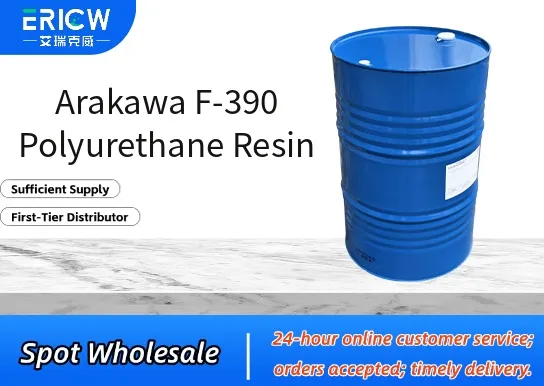
Q1: What is the primary function of Arakawa F-390 in polyurethane formulations?
A: Arakawa F-390 is a reactive polyurethane resin designed to serve as a chain extender and crosslinking agent, enhancing mechanical strength, abrasion resistance, and thermal stability in thermosetting PU systems such as coatings, adhesives, and elastomers.
Q2: Is Arakawa F-390 compatible with aromatic and aliphatic isocyanates?
A: Yes — F-390 demonstrates broad compatibility with both aromatic (e.g., MDI, TDI derivatives) and aliphatic (e.g., HDI, IPDI-based) isocyanates, making it suitable for formulating light-stable and non-yellowing PU systems where required.
Q3: How should Arakawa F-390 be handled and stored to maintain its reactivity?
A: Store in tightly sealed containers under dry, inert conditions (e.g., nitrogen blanket) at room temperature. Minimize exposure to moisture, heat, and ambient air during handling, as F-390 contains reactive hydroxyl groups that may undergo premature reaction or viscosity increase upon prolonged contact with humidity.
Q4: Can Arakawa F-390 be used in solvent-free or high-solids PU systems?
A: Yes — its low volatility and tailored molecular weight allow effective incorporation into solvent-free, high-solids, and UV-curable hybrid PU formulations without significant viscosity penalty or outgassing concerns.
Contact With Us:
E-mail: wangxingqiang@ericwchem.com
Have a Questions? Call Us:
Add:
Building A1, Jiete Industrial Park, Huangpu District, Guangzhou City, Guangdong Province, China