English
 Español
 tiếng việt
 русский
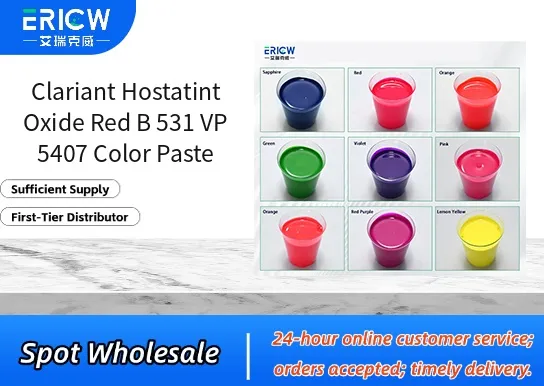
Highly concentrated iron oxide-based pigment dispersion for efficient coloration with low dosage requirements.
Excellent lightfastness and weather resistance suitable for demanding outdoor applications.
Optimized rheology for easy incorporation into water-based and solvent-based systems without destabilization.
Consistent batch-to-batch color reproducibility ensured by Clariant’s stringent quality control protocols.
REACH-compliant formulation with no intentionally added heavy metals or restricted substances.
Architectural coatings including exterior masonry paints and stucco finishes.
Cementitious products such as colored concrete, paving slabs, and precast elements.
Plaster and render systems requiring durable, alkali-stable red hues.
Tile adhesives and grouts where long-term color stability under humid conditions is critical.
Industrial maintenance coatings for infrastructure and metal substrates.
| Chemical Type | Iron oxide (α-Fe₂O₃) pigment dispersion |
| Product Form | Liquid color paste |
| Appearance | Viscous, homogeneous red paste |
| Primary Applications | Water-based and solvent-based architectural coatings, cementitious materials |
| Key Features | Alkali stable, non-bleeding, low VOC |
| Recommended pH Range | 6.5 – 10.5 |
| Storage Stability | 12 months at 5–30 °C in sealed original container |
| Compliance | REACH registered; compliant with EU Directive 2004/42/EC (VOC limits) |
Q1: What is the primary application field for Hostatint Oxide Red B 531 VP 5407?
A: This pigment paste is specifically formulated for coloring polyolefin-based compounds, especially in applications requiring good thermal stability and dispersion performance during extrusion or injection molding — such as automotive interior parts, industrial containers, and technical components.
Q2: Is this color paste suitable for food-contact plastics?
A: Hostatint Oxide Red B 531 VP 5407 is not pre-qualified for direct food-contact applications. Its use in food-contact plastics requires full regulatory assessment by the end-user, including compliance verification with applicable regional regulations and migration testing under intended conditions of use.
Q3: How should this paste be incorporated into polyolefin compounds?
A: It is typically added directly to the polymer matrix during compounding — either via side-feeding into an extruder or pre-blended with carrier resin. Good dispersion is achieved under standard melt processing conditions; avoid excessive shear or prolonged residence time at elevated temperatures to preserve color integrity.
Q4: What are the key handling and storage recommendations?
A: Store in original sealed containers at temperatures between 5 °C and 30 °C, away from direct sunlight and sources of heat. Avoid freezing. Stir gently before use if sedimentation occurs after prolonged storage. Ensure compatibility testing is performed when combining with other additives or pigments.
Contact With Us:
E-mail: wangxingqiang@ericwchem.com
Have a Questions? Call Us:
Add:
Building A1, Jiete Industrial Park, Huangpu District, Guangzhou City, Guangdong Province, China