English
 Español
 tiếng việt
 русский
Excellent abrasion resistance for extended service life in demanding mechanical environments.
High tensile strength and elongation at break, enabling reliable performance under dynamic stress.
Good low-temperature flexibility down to –30 °C, maintaining elasticity in cold-condition applications.
Outstanding processability via extrusion and injection molding with minimal thermal degradation.
Hydrolysis-resistant formulation suitable for humid or intermittent wet-service conditions.
Automotive interior trim components including gear knobs, armrests, and soft-touch overlays.
Industrial hoses and pneumatic tubing requiring kink resistance and pressure stability.
Consumer electronics protective casings and wearable device straps with skin-friendly feel.
Medical device tubing and non-sterile housing parts compliant with ISO 10993-5 cytotoxicity screening.
Footwear midsoles and outsole compounds balancing cushioning, rebound, and wear durability.
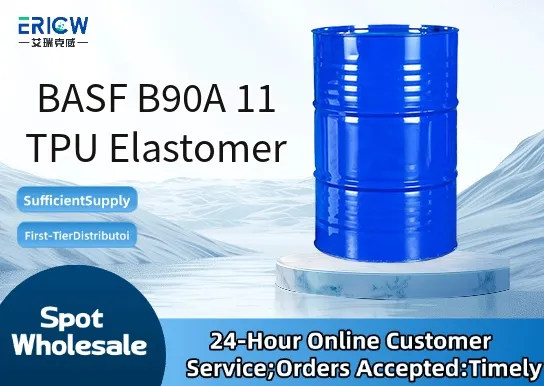
| Chemical Type | Thermoplastic Polyurethane (TPU), Polyester-based |
| Product Form | Natural-colored granules, free-flowing |
| Appearance | Opaque, beige to light tan pellets |
| Primary Applications | Extrusion, injection molding, profile co-extrusion |
| Key Features | Abrasion resistance, flexibility, melt processability, hydrolysis stability |
| Benefits | Reduced part weight vs. thermosets, recyclable scrap, no vulcanization required |
| Density (ISO 1183) | 1.20–1.22 g/cm³ |
| Melt Flow Index (ISO 1133, 210 °C/5 kg) | 10–14 g/10 min |
Q1: What are the key processing advantages of BASF B90A 11 compared to conventional TPU grades?
A: BASF B90A 11 is specifically engineered for enhanced melt stability and reduced viscosity at processing temperatures, enabling smoother extrusion and injection molding—particularly beneficial for thin-walled or highly detailed parts. Its optimized thermal profile supports shorter cycle times and improved surface finish without sacrificing mechanical resilience.
Q2: Is B90A 11 suitable for applications requiring resistance to hydrolysis and low-temperature flexibility?
A: Yes—B90A 11 is an aliphatic polyester-based TPU with inherently good hydrolytic stability and retains excellent elasticity down to -30 °C. It is well-suited for outdoor or humid-environment applications where long-term performance under moisture exposure and thermal cycling is critical.
Q3: Can B90A 11 be co-extruded or overmolded with other thermoplastics?
A: B90A 11 demonstrates good adhesion to common engineering thermoplastics such as PP, ABS, and PC when processed under appropriate temperature and surface-energy conditions. Successful bonding typically requires controlled melt temperature windows and may benefit from surface pre-treatment or compatible tie-layer formulations.
Q4: How does B90A 11 perform in terms of UV resistance and color stability?
A: As an aliphatic TPU, B90A 11 offers superior UV resistance and minimal yellowing compared to aromatic TPUs. It maintains color fidelity and mechanical integrity during extended outdoor exposure, making it a preferred choice for transparent or light-colored exterior components.
Contact With Us:
E-mail: wangxingqiang@ericwchem.com
Have a Questions? Call Us:
Add:
Building A1, Jiete Industrial Park, Huangpu District, Guangzhou City, Guangdong Province, China