English
 Español
 tiếng việt
 русский
Excellent abrasion resistance for extended service life in demanding mechanical environments.
Outstanding flexibility and resilience at low temperatures down to –40 °C.
Good oil, grease, and hydrocarbon resistance suitable for industrial fluid-contact applications.
High tensile strength and elongation balance for dynamic part performance.
Processable via standard thermoplastic methods including extrusion, injection molding, and blow molding.
Industrial hoses and suction/discharge tubing for material handling systems.
Roller covers and wear strips for conveyor and material processing equipment.
Seals, gaskets, and dynamic sealing components in hydraulic and pneumatic systems.
Protective sheathing for cables and wire harnesses in harsh environments.
Footwear midsoles and performance outsoles requiring durable cushioning and rebound.
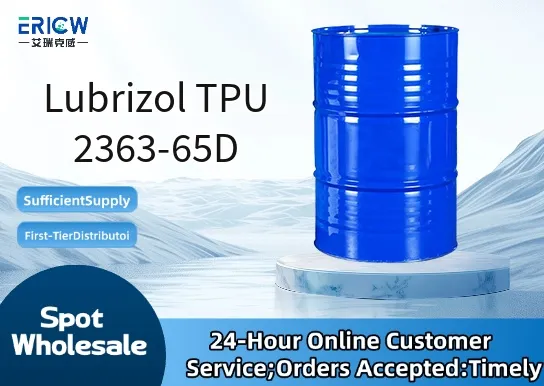
| Chemical Type | Thermoplastic Polyurethane (TPU), Polyester-based |
| Product Form | Pellets |
| Appearance | Off-white to light tan, free-flowing pellets |
| Shore Hardness (ASTM D2240) | 65 D |
| Density (ASTM D792) | 1.20–1.23 g/cm³ |
| Melt Flow Rate (ASTM D1238, 210 °C/2.16 kg) | 15–22 g/10 min |
| Primary Applications | Industrial tubing, wear parts, seals, cable jacketing, footwear |
| Key Features | Abrasion resistance, low-temperature flexibility, oil resistance, processability |
Q1: What is Lubrizol TPU 2363-65D primarily used for?
A: Lubrizol TPU 2363-65D is a thermoplastic polyurethane elastomer designed for demanding extrusion and injection molding applications, especially where high melt strength, excellent abrasion resistance, and good low-temperature flexibility are required — commonly used in automotive interior trim, industrial hoses, and premium consumer goods.
Q2: Is this grade suitable for processing via twin-screw extrusion?
A: Yes, TPU 2363-65D exhibits good thermal stability and consistent melt rheology, making it well-suited for twin-screw extrusion — including compounding with additives, masterbatches, or fillers — provided standard TPU drying and temperature profiling guidelines are followed.
Q3: How does its hardness compare to other TPU grades in the 2363 series?
A: As indicated by the “65D” designation, this grade has a Shore D hardness of approximately 65, positioning it between softer Shore A TPUs and harder, more rigid D-scale variants — offering a balanced combination of toughness, elasticity, and dimensional stability.
Q4: Can it be overmolded onto common engineering plastics like PP or ABS?
A: While TPU 2363-65D demonstrates good adhesion to many substrates, successful overmolding onto PP or ABS typically requires surface pretreatment (e.g., plasma or flame treatment) and careful optimization of mold temperature, melt temperature, and bonding time — adhesion performance should be validated in the final application environment.
Contact With Us:
E-mail: wangxingqiang@ericwchem.com
Have a Questions? Call Us:
Add:
Building A1, Jiete Industrial Park, Huangpu District, Guangzhou City, Guangdong Province, China