English
 Español
 tiếng việt
 русский
Excellent abrasion resistance for demanding mechanical environments.
Outstanding flexibility and low-temperature performance down to –30 °C.
Good oil, grease, and hydrocarbon resistance suitable for industrial contact scenarios.
High tensile strength and elongation at break for dynamic component applications.
Compatible with common thermoplastic processing methods including extrusion, injection molding, and blow molding.
Automotive interior trim and soft-touch components.
Industrial hoses and pneumatic tubing requiring flex fatigue resistance.
Wire and cable jacketing for enhanced durability and flame-retardant formulation compatibility.
Footwear midsoles and outsoles demanding rebound and wear resilience.
Conveyor belts and scraper blades in material handling systems.
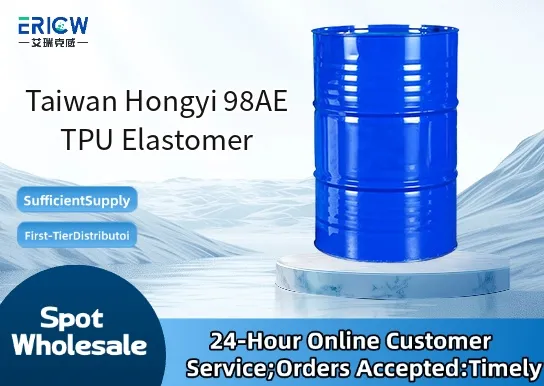
| Chemical Type | Thermoplastic Polyurethane (TPU), Polyester-based |
| Product Form | Pellets |
| Appearance | Translucent, natural-colored granules |
| Density (g/cm³) | 1.18–1.22 |
| Melt Flow Index (2.16 kg, 200 °C) | 10–14 g/10 min |
| Hardness (Shore A) | 98 ± 2 |
| Tensile Strength (MPa) | 42–48 |
| Elongation at Break (%) | 500–600 |
Q1: What are the key processing advantages of Taiwan Hongyi 98AE compared to conventional TPU grades?
A: Taiwan Hongyi 98AE offers enhanced melt flow and reduced viscosity during extrusion and injection molding, enabling smoother processing at lower temperatures and shorter cycle times. Its balanced hardness and elasticity also support excellent dimensional stability and surface finish in thin-walled or complex geometries.
Q2: Is 98AE suitable for applications requiring long-term flexibility and low-temperature performance?
A: Yes — as an aliphatic polyester-based TPU elastomer, 98AE maintains good elasticity, resilience, and crack resistance down to approximately −30 °C. It is commonly selected for dynamic components exposed to repeated flexing or thermal cycling in outdoor or automotive environments.
Q3: How does 98AE perform in terms of hydrolytic stability and UV resistance?
A: Due to its aliphatic structure and optimized polymer architecture, 98AE exhibits superior hydrolytic stability compared to many aromatic TPUs, especially under warm, humid conditions. It also demonstrates good inherent UV resistance without requiring additional stabilizers, making it suitable for non-pigmented or lightly pigmented outdoor applications.
Q4: Can 98AE be blended with other thermoplastics or elastomers?
A: Yes — 98AE shows favorable compatibility with several engineering thermoplastics such as PC, ABS, and certain polyesters, particularly when used as a toughening modifier. Compatibility should be verified experimentally for each specific blend system, and compatibilizers may be recommended for optimal phase dispersion and mechanical performance.
Contact With Us:
E-mail: wangxingqiang@ericwchem.com
Have a Questions? Call Us:
Add:
Building A1, Jiete Industrial Park, Huangpu District, Guangzhou City, Guangdong Province, China