English
 Español
 tiếng việt
 русский
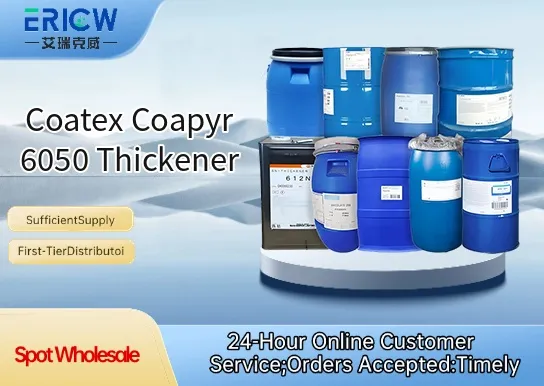
High-efficiency associative thickener delivering excellent rheology control in waterborne systems.
Provides outstanding sag resistance and leveling balance in architectural and industrial coatings.
Compatible with a broad range of anionic, nonionic, and cationic surfactants and co-thickeners.
Stable performance across pH range 4–11 without viscosity loss or gel formation.
Low VOC and APEO-free formulation compliant with global environmental regulations.
Interior and exterior architectural latex paints.
Waterborne industrial maintenance coatings.
Wood and metal primers requiring high shear viscosity control.
Textured coatings and decorative finishes.
Emulsion-based adhesives and sealants.
| Chemical Type | Hydrophobically modified ethoxylated urethane (HEUR) |
| Product Form | Clear to slightly hazy aqueous liquid |
| Appearance | Light amber viscous liquid |
| pH (1% aqueous solution) | 6.5–7.5 |
| Active Content | 30.0 ± 1.0 wt% |
| Viscosity (Brookfield RVT, spindle #3, 20 rpm, 25°C) | 800–1,500 mPa·s |
| Freeze-Thaw Stability | Passes 3 cycles (−15°C for 16 h / 23°C for 8 h) |
| Primary Applications | Architectural and industrial waterborne coatings |
Q1: What type of thickener is Coatex Coapyr 6050?
A: Coatex Coapyr 6050 is a hydrophobically modified ethoxylated urethane (HEUR) associative thickener, designed to provide efficient rheology control and excellent shear-thinning behavior in water-based systems.
Q2: In which types of formulations is Coapyr 6050 commonly used?
A: It is widely employed in architectural coatings, industrial maintenance paints, and waterborne wood finishes where balanced viscosity development, good leveling, spatter resistance, and sag resistance are required.
Q3: How should Coapyr 6050 be incorporated into a formulation?
A: It is typically added during the let-down stage, after pigments and primary thickeners, under moderate agitation. Pre-dilution with water or co-solvent may improve dispersion and reduce localized overdosing.
Q4: Does Coapyr 6050 require pH adjustment for optimal performance?
A: While it performs well across a broad pH range (typically pH 7–10), stable viscosity development is best achieved when the formulation pH is maintained above 7.5 to ensure full ionization of associated components.
Q5: Is Coapyr 6050 compatible with other rheology modifiers?
A: Yes—it is frequently used in combination with cellulosic or clay-based thickeners to fine-tune rheological profiles, though compatibility testing is recommended to avoid antagonistic interactions or viscosity loss.
Contact With Us:
E-mail: wangxingqiang@ericwchem.com
Have a Questions? Call Us:
Add:
Building A1, Jiete Industrial Park, Huangpu District, Guangzhou City, Guangdong Province, China