English
 Español
 tiếng việt
 русский
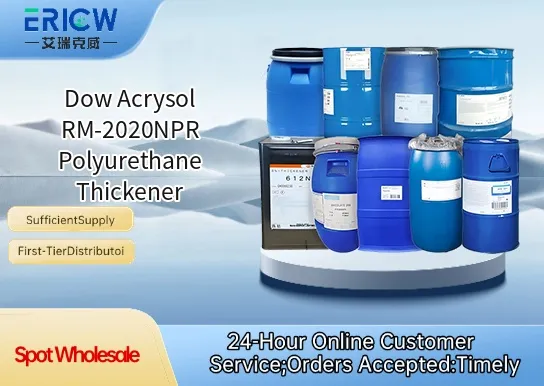
Non-ionic, hydrophobically modified polyurethane (HEUR) rheology modifier for robust viscosity control.
Delivers excellent sag resistance and leveling in waterborne coatings without compromising flow.
Compatible with a broad range of surfactants, co-thickeners, and functional additives.
Enables low-shear viscosity build and strong high-shear thinning behavior for spray and roll application.
Stable across pH 4–10 and tolerant to moderate levels of electrolytes and freeze-thaw cycles.
Architectural interior and exterior latex paints.
Industrial maintenance coatings and protective topcoats.
Wood and metal decorative coatings.
Waterborne primers and undercoats.
Low-VOC and zero-VOC decorative and functional coatings.
| Chemical Type | Hydrophobically Modified Polyurethane (HEUR) |
| Product Form | Clear to slightly hazy aqueous dispersion |
| Appearance | Off-white to light amber liquid |
| Primary Applications | Waterborne architectural and industrial coatings |
| Key Features | Non-ionic, shear-thinning, electrolyte-tolerant |
| Benefits | Improved sag resistance, leveling, and spatter control |
| pH Range (as supplied) | 7.0–9.0 |
| Recommended Use Level | 0.1–0.8 wt% (based on total formulation) |
Q1: What is the primary function of Acrysol RM-2020NPR in waterborne coatings?
A: Acrysol RM-2020NPR is a non-ionic, hydrophobically modified polyurethane (HEUR) rheology modifier designed to provide efficient thickening and excellent flow/leveling balance in low-VOC, waterborne architectural and industrial coatings. It imparts pseudoplastic behavior, enhancing sag resistance while maintaining good application properties.
Q2: How does RM-2020NPR differ from associative acrylic thickeners like Acrysol ASE or HASE types?
A: Unlike associative acrylic thickeners that rely on carboxylic acid groups and pH activation, RM-2020NPR functions independently of pH and provides stronger associative network formation through hydrophobic junctions. This results in superior mid-shear viscosity development, better water sensitivity resistance, and improved compatibility with surfactants and coalescing agents commonly used in modern formulations.
Q3: What is the recommended addition method for optimal performance?
A: RM-2020NPR is typically added during the let-down stage, after pigments and fillers have been dispersed and the base has been adjusted for pH and conductivity. It should be diluted with water or a compatible solvent prior to slow, high-shear addition to ensure uniform distribution and prevent localized over-thickening or gel formation.
Q4: Is RM-2020NPR compatible with biocides and other common additives?
A: Yes, RM-2020NPR demonstrates broad compatibility with standard isothiazolinone and benzisothiazole-based biocides, as well as common defoamers, dispersants, and coalescents. However, compatibility testing is always recommended when introducing new additives or at higher usage levels to confirm stability and rheological performance.
Q5: Can RM-2020NPR be used in high-solids or low-water-content systems?
A: While RM-2020NPR is optimized for conventional waterborne systems, it can perform effectively in reduced-water formulations—such as high-solids architectural paints—provided sufficient water remains to support micelle formation and hydrophobic association. Performance should be verified experimentally, as very low water content may limit its associative thickening mechanism.
Contact With Us:
E-mail: wangxingqiang@ericwchem.com
Have a Questions? Call Us:
Add:
Building A1, Jiete Industrial Park, Huangpu District, Guangzhou City, Guangdong Province, China