English
 Español
 tiếng việt
 русский
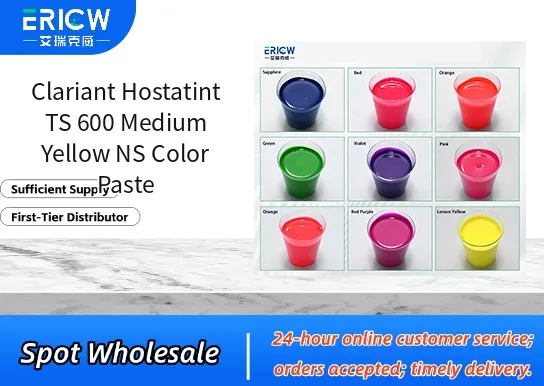
High chroma, lightfast medium yellow shade with excellent batch-to-batch consistency.
Non-bleeding formulation optimized for polyolefin applications including PP and PE.
Low migration behavior ensuring color stability during processing and end-use.
NS (Non-Staining) grade specifically developed to minimize surface staining on adjacent materials.
Ready-to-use liquid paste with optimized rheology for easy dosing and homogeneous dispersion.
Polypropylene (PP) fibers and nonwovens for hygiene and filtration products.
Polyethylene (PE) blow-molded containers and thin-walled packaging.
Injection-molded automotive interior components requiring low-staining performance.
Household appliances and consumer electronics housings where color fidelity is critical.
Technical textiles requiring UV resistance and thermal stability during extrusion.
| Chemical Type | Azo-based organic pigment dispersion |
| Product Form | Liquid color paste (solvent-free) |
| Appearance | Homogeneous, viscous yellow paste |
| Primary Applications | Polyolefins (PP, HDPE, LDPE), nonwovens, injection molding |
| Key Features | Non-staining (NS), low migration, high thermal stability (up to 280°C) |
| Benefits | Excellent dispersion, minimal filter clogging, compliance with FDA 21 CFR §178.3297 |
| VOC Content | ≤ 0.5% (w/w) |
| Recommended Dosage Range | 0.5–3.0 wt% depending on substrate and opacity requirements |
Q1: What is the primary application field for Hostatint TS 600 Medium Yellow NS?
A: Hostatint TS 600 Medium Yellow NS is specifically developed for coloring polyolefin-based packaging materials, including flexible films, blow-molded containers, and injection-molded closures, where good thermal stability and low migration are required.
Q2: Is this color paste suitable for food-contact applications?
A: Yes, Hostatint TS 600 Medium Yellow NS is formulated to meet regulatory expectations for food-contact plastics in major global markets, subject to compliance with applicable local requirements and final formulation validation.
Q3: How should the paste be incorporated into polyolefin compounds?
A: It is typically added directly to the polymer melt during extrusion or injection molding using standard gravimetric or volumetric dosing systems; pre-blending with a carrier resin may be used for improved dispersion in high-viscosity matrices.
Q4: What are the key handling and storage recommendations?
A: Store in original sealed containers at temperatures between 5 °C and 30 °C, away from direct sunlight and sources of heat; avoid freezing and prolonged exposure to high humidity to maintain paste consistency and dispersibility.
Contact With Us:
E-mail: wangxingqiang@ericwchem.com
Have a Questions? Call Us:
Add:
Building A1, Jiete Industrial Park, Huangpu District, Guangzhou City, Guangdong Province, China