English
 Español
 tiếng việt
 русский
Excellent mechanical strength and dimensional stability after curing.
Good compatibility with standard styrene monomers and common accelerators/inhibitors.
Low viscosity for easy handling, improved fiber wet-out, and efficient impregnation.
Consistent reactivity profile enabling reliable processing in spray-up, hand lay-up, and centrifugal casting.
Enhanced weather resistance and UV stability when formulated with appropriate additives.
Fiberglass-reinforced plastic (FRP) tanks and chemical storage vessels.
Marine components including boat hulls, decks, and structural laminates.
Industrial grating, ductwork, and corrosion-resistant linings.
Automotive body panels and under-hood composite parts.
Wind turbine blade substructures and nacelle enclosures.
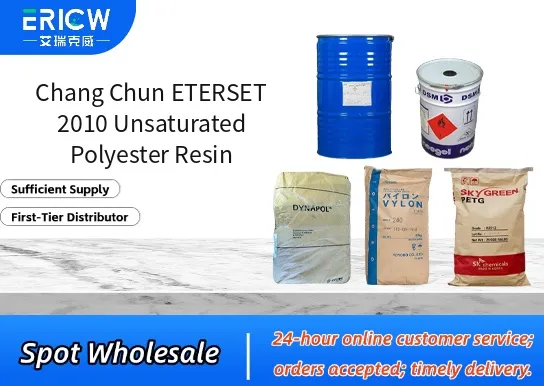
| Chemical Type | Unsaturated polyester resin (orthophthalic-based) |
| Product Form | Liquid |
| Appearance | Clear to pale yellow viscous liquid |
| Viscosity (25°C, mPa·s) | 350–550 |
| Solid Content (% w/w) | ≈99.5 |
| Styrene Content (% w/w) | 38–42 |
| Gel Time (with 1% MEKP, 25°C, min) | 18–25 |
| Primary Applications | Structural FRP laminates requiring balanced performance and processability |
Q1: What are the primary curing systems compatible with ETERSET 2010?
A: ETERSET 2010 is designed for free-radical polymerization and is typically cured using organic peroxides such as methyl ethyl ketone peroxide (MEKP) or benzoyl peroxide (BPO), often in combination with cobalt-based accelerators. Cure performance may vary depending on ambient conditions, filler content, and inhibitor levels.
Q2: Is ETERSET 2010 suitable for structural composite applications like pultrusion or filament winding?
A: Yes — ETERSET 2010 offers balanced reactivity, good mechanical build-up, and low exotherm characteristics, making it well-suited for medium-to-high-speed pultrusion and continuous filament winding processes where dimensional stability and resin flow control are critical.
Q3: How does ETERSET 2010 perform in terms of post-cure shrinkage and surface hardness?
A: This resin exhibits moderate shrinkage during cure — lower than many general-purpose orthophthalic resins — contributing to improved dimensional fidelity and reduced warpage. Final surface hardness is generally high after full post-cure, supporting good abrasion resistance and finish retention in reinforced laminates.
Q4: Can ETERSET 2010 be blended with other unsaturated polyester resins or vinyl esters?
A: Blending with other unsaturated polyesters is technically feasible and sometimes used to fine-tune viscosity, reactivity, or final properties — however, compatibility must be verified experimentally for each intended blend ratio, as phase separation or inconsistent cure behavior may occur. Mixing with vinyl esters is not generally recommended without thorough formulation validation.
Contact With Us:
E-mail: wangxingqiang@ericwchem.com
Have a Questions? Call Us:
Add:
Building A1, Jiete Industrial Park, Huangpu District, Guangzhou City, Guangdong Province, China