English
 Español
 tiếng việt
 русский
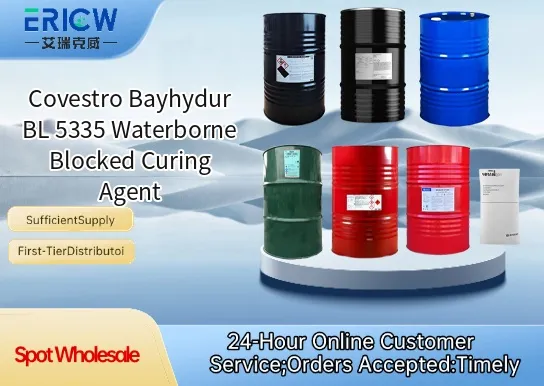
Waterborne, VOC-compliant formulation supporting sustainable coating systems.
Blocked isocyanate chemistry enabling ambient-cure storage stability and heat-activated crosslinking.
Excellent compatibility with acrylic, polyester, and polyurethane dispersions.
Delivers high film hardness, chemical resistance, and gloss retention after curing.
Low free monomer content, meeting stringent regulatory requirements for industrial coatings.
Automotive OEM and refinish clearcoats and basecoats.
Industrial maintenance coatings for metal substrates.
Wood finishing systems requiring low-temperature cure profiles.
Plastic coatings for automotive interior parts and electronics housings.
High-performance coil coatings for architectural and appliance applications.
| Chemical Type | Blocked aliphatic polyisocyanate (hexamethylene diisocyanate derivative) |
| Product Form | Aqueous dispersion |
| Appearance | Clear to slightly hazy, colorless to pale yellow liquid |
| pH (25 °C) | 7.0 – 8.5 |
| Solids Content (wt.%) | 45 – 49 |
| Viscosity (mPa·s, 25 °C, Brookfield RVT, spindle #3, 10 rpm) | 150 – 350 |
| Density (g/cm³, 20 °C) | 1.05 – 1.10 |
| Storage Stability (sealed container, 25 °C) | ≥ 6 months |
Q1: What is the primary function of Bayhydur BL 5335 in waterborne coating systems?
A: Bayhydur BL 5335 is a water-dispersible, blocked aliphatic polyisocyanate curing agent designed to provide ambient-cure or low-bake crosslinking capability in aqueous two-component polyurethane systems. Its blocked chemistry enables improved pot life and storage stability while delivering good film hardness, chemical resistance, and gloss retention after thermal de-blocking and cure.
Q2: Which types of resins is Bayhydur BL 5335 typically compatible with?
A: It is formulated for use with waterborne hydroxyl-functional acrylics, polyesters, and hybrid dispersions. Compatibility and performance depend on resin selection, pH, ionic character, and formulation additives — pre-testing under intended processing and cure conditions is strongly recommended.
Q3: What are the typical cure conditions required to activate Bayhydur BL 5335?
A: Full crosslinking requires thermal activation, generally in the range of 100–140 °C for 10–30 minutes, depending on substrate, film thickness, and heating profile. Some degree of ambient cure may occur over extended periods, but optimal performance properties are achieved only after proper thermal de-blocking and reaction.
Q4: How should Bayhydur BL 5335 be incorporated into a waterborne formulation?
A: It is added as the curing component during the final mixing stage, typically under gentle agitation and at temperatures below 40 °C to avoid premature de-blocking. The dispersion is stable in neutral to mildly alkaline aqueous media; avoid strong acids or highly reactive solvents that may destabilize the system or trigger early reaction.
Contact With Us:
E-mail: wangxingqiang@ericwchem.com
Have a Questions? Call Us:
Add:
Building A1, Jiete Industrial Park, Huangpu District, Guangzhou City, Guangdong Province, China