English
 Español
 tiếng việt
 русский
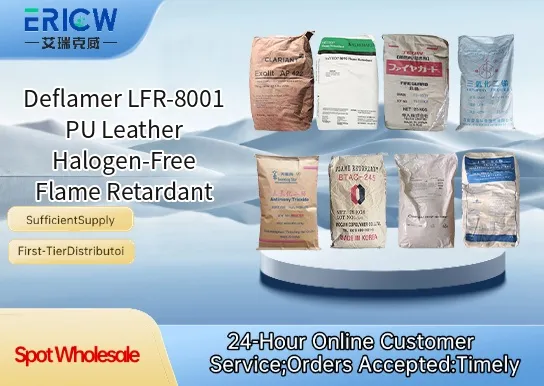
Halogen-free formulation ensures compliance with RoHS, REACH, and UL 94 HF-1 standards.
Excellent compatibility with polyurethane (PU) leather systems without compromising tensile strength or flexibility.
Low migration tendency — maintains flame retardancy performance over time and after repeated flexing.
Thermally stable up to 220 °C, enabling safe processing during hot-calendering and lamination.
Non-blooming surface finish preserves aesthetic quality and adhesion in finished leather products.
Automotive interior trim: seat covers, door panels, and dashboard overlays.
Furniture upholstery for contract and residential settings requiring B1/DIN 4102 or ASTM E84 Class A certification.
Railway and marine cabin interiors meeting EN 45545-2 and IMO FTP Code requirements.
Healthcare facility seating and wall cladding where low smoke toxicity and halogen-free safety are mandated.
High-end synthetic leather goods including handbags, footwear, and accessories targeting eco-conscious brands.
| Chemical Type | Organophosphorus-based synergistic flame retardant |
| Product Form | Free-flowing white to off-white powder |
| Appearance | Fine, homogeneous granular powder |
| Primary Applications | Flame retardant additive for solvent-based and water-based PU leather coatings and films |
| Key Features | Halogen-free, non-migrating, low volatility, UL 94 HF-1 rated |
| Recommended Loading Range | 12–18 wt% in PU resin solids (varies by formulation and thickness) |
| Density (25 °C) | 1.42–1.46 g/cm³ |
| Storage Conditions | Store in cool, dry place below 30 °C; keep container tightly sealed |
Q1: What makes Deflamer LFR-8001 suitable for PU leather applications specifically?
A: Deflamer LFR-8001 is specially engineered for polyurethane-based leather systems, offering excellent compatibility with PU resins and solvents while maintaining film integrity, flexibility, and surface aesthetics—without blooming or migration issues commonly observed with conventional halogen-free alternatives.
Q2: How does LFR-8001 achieve flame retardancy without halogens?
A: It utilizes a synergistic phosphorus–nitrogen intumescent mechanism that promotes rapid char formation upon thermal exposure, effectively insulating the underlying PU substrate and suppressing smoke and heat release—meeting stringent halogen-free requirements for indoor and automotive upholstery.
Q3: Is LFR-8001 compatible with common PU leather coating and laminating processes?
A: Yes—it is fully dispersible in standard PU coating formulations and remains stable during solvent evaporation, calendering, and hot-laminating steps. It does not interfere with catalyst activity or post-curing performance, supporting both wet-process and dry-process manufacturing lines.
Q4: Does LFR-8001 affect the physical properties of finished PU leather?
A: When properly formulated, it preserves key mechanical attributes—including tensile strength, elongation, and abrasion resistance—and shows no adverse impact on color stability, adhesion, or low-temperature flexibility under typical usage conditions.
Contact With Us:
E-mail: wangxingqiang@ericwchem.com
Have a Questions? Call Us:
Add:
Building A1, Jiete Industrial Park, Huangpu District, Guangzhou City, Guangdong Province, China