English
 Español
 tiếng việt
 русский
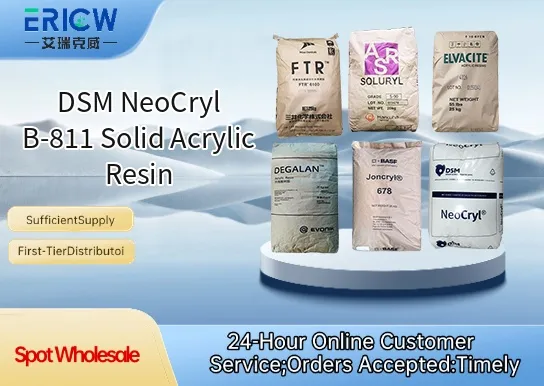
High molecular weight solid acrylic resin offering excellent film hardness and scratch resistance.
Low yellowing tendency, ensuring long-term clarity and color stability in demanding applications.
Good solubility in common organic solvents including esters, ketones, and aromatic hydrocarbons.
Enables high-gloss, smooth finishes with outstanding leveling and flow characteristics.
Compatible with a broad range of crosslinkers (e.g., melamine, isocyanate) for thermoset coating systems.
Automotive refinish clearcoats and basecoats.
Industrial maintenance coatings for metal substrates.
General-purpose decorative and protective topcoats.
Plastic coatings requiring high gloss and abrasion resistance.
Wood coatings where clarity, hardness, and chemical resistance are critical.
| Chemical Type | Acrylic Copolymer |
| Product Form | Free-flowing white to off-white solid granules or powder |
| Appearance | White to light beige granular solid |
| Glass Transition Temperature (Tg) | ~75 °C (by DSC, 10 °C/min) |
| Solubility | Readily soluble in xylene, butyl acetate, MEK, and MIBK |
| Volatile Organic Content (VOC) | Non-volatile (100% solids) |
| Key Features | High hardness, low yellowing, excellent gloss retention |
| Primary Applications | High-performance solventborne coatings for automotive, industrial, and plastic substrates |
Q1: What is the primary function of NeoCryl B-811 in coating formulations?
A: NeoCryl B-811 is a solid acrylic resin designed primarily as a film-forming binder and rheology modifier in high-solids, low-VOC architectural and industrial coatings. It contributes to improved scrub resistance, gloss retention, and substrate adhesion without requiring high levels of coalescing solvents.
Q2: Is NeoCryl B-811 compatible with common waterborne acrylic emulsions and polyurethane dispersions?
A: Yes, NeoCryl B-811 demonstrates broad compatibility with standard anionic and nonionic waterborne acrylic emulsions, as well as aliphatic polyurethane dispersions. Compatibility should be verified in the final formulation due to sensitivity to pH, ionic strength, and surfactant systems.
Q3: How is NeoCryl B-811 typically incorporated into aqueous systems?
A: It is generally dispersed using high-shear mixing—often during the let-down stage—after partial swelling in water or a water-miscible solvent (e.g., glycol ethers). Pre-dispersion with mild agitation helps avoid agglomeration, and full incorporation may require extended mixing time depending on system viscosity and temperature.
Q4: Does NeoCryl B-811 contribute to improved freeze-thaw stability in waterborne coatings?
A: While not a dedicated freeze-thaw stabilizer, NeoCryl B-811’s solid particle morphology and low water sensitivity can support enhanced formulation robustness under thermal cycling—particularly when combined with appropriate protective colloids and co-binders. Performance depends on overall formulation design.
Contact With Us:
E-mail: wangxingqiang@ericwchem.com
Have a Questions? Call Us:
Add:
Building A1, Jiete Industrial Park, Huangpu District, Guangzhou City, Guangdong Province, China