English
 Español
 tiếng việt
 русский
High hydroxyl functionality for excellent crosslinking density with melamine and polyisocyanate curing agents.
Low VOC formulation compliant with stringent environmental regulations including EU Directive 2004/42/EC.
Superior gloss retention and long-term weatherability in outdoor coating applications.
Excellent compatibility with common solventborne acrylic and polyester resins.
Good flow and leveling characteristics for high-quality finish in industrial coil and automotive refinish coatings.
Automotive OEM and refinish topcoats.
Industrial coil coatings for pre-painted metal substrates.
General metal finishing coatings for appliances and furniture.
High-performance can coatings for food and beverage containers.
Architectural metal cladding and façade systems.
| Chemical Type | Hydroxyl-functional acrylic copolymer |
| Product Form | Solventborne liquid resin |
| Appearance | Clear, pale yellow to colorless liquid |
| Solvent System | Xylene / butyl acetate / isopropanol blend |
| Non-Volatile Content (wt%) | 60 ± 1 % |
| Hydroxyl Value | 58–62 mg KOH/g |
| Acid Value | < 5 mg KOH/g |
| Viscosity (25°C, Brookfield LV, spindle #3, 60 rpm) | 1,800–2,400 cP |
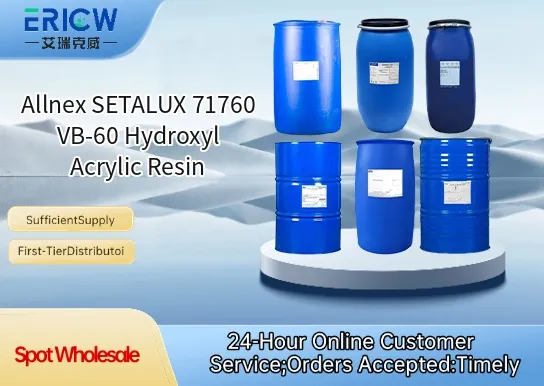
Q1: What is the primary function of SETALUX 71760 VB-60 in coating formulations?
A: SETALUX 71760 VB-60 serves as a hydroxyl-functional acrylic resin, primarily used as a co-resin or crosslinker partner for polyisocyanate curing agents in two-component polyurethane systems. It contributes to film hardness, chemical resistance, and gloss retention while maintaining good flow and leveling properties.
Q2: Is this resin suitable for high-solids or low-VOC coating applications?
A: Yes — SETALUX 71760 VB-60 is formulated with a balanced molecular weight and low viscosity, making it well-suited for high-solids 2K PU systems. Its design supports VOC reduction strategies without compromising reactivity or film performance.
Q3: How does SETALUX 71760 VB-60 compare to other hydroxyl acrylic resins in terms of yellowing resistance?
A: As a purely acrylic-based hydroxyl resin, SETALUX 71760 VB-60 offers excellent inherent resistance to yellowing under UV exposure and thermal aging — significantly outperforming alkyd- or polyester-modified alternatives in demanding decorative and protective topcoat applications.
Q4: Can it be blended with other resin types, such as polyester polyols or epoxy resins?
A: Compatibility with polyester polyols is generally good and often leveraged to balance flexibility and durability. However, blending with epoxy resins is not recommended due to potential side reactions and instability in storage; formulation testing is always advised before introducing new resin combinations.
Contact With Us:
E-mail: wangxingqiang@ericwchem.com
Have a Questions? Call Us:
Add:
Building A1, Jiete Industrial Park, Huangpu District, Guangzhou City, Guangdong Province, China