English
 Español
 tiếng việt
 русский
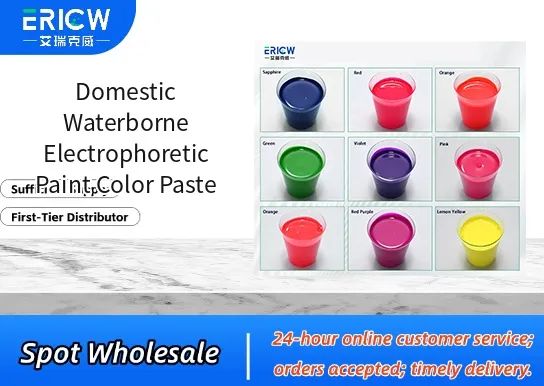
Waterborne formulation eliminates volatile organic compound (VOC) emissions, supporting stringent environmental compliance.
High pigment loading ensures excellent color strength and batch-to-batch consistency in electrophoretic deposition (EDP) processes.
Optimized rheology and colloidal stability prevent sedimentation during storage and ensure uniform dispersion in E-coat bath systems.
Compatible with standard cationic electrophoretic paint systems without requiring process modification or additional additives.
Non-toxic, non-hazardous classification simplifies handling, transportation, and workplace safety management.
Automotive chassis and underbody components requiring corrosion-resistant, uniformly pigmented E-coat finishes.
Home appliance metal parts—including refrigerator cabinets, washing machine drums, and oven housings.
Construction hardware such as door hinges, handles, and structural steel fittings exposed to indoor environments.
Office furniture frames and modular partition systems demanding durable, low-VOC decorative and protective coatings.
Electrical enclosures and control panels where consistent color appearance and dielectric integrity are critical.
| Chemical Type | Cationic waterborne pigment dispersion |
| Product Form | Viscous liquid paste |
| Appearance | Homogeneous, non-settling suspension; color-specific hue and opacity |
| Primary Applications | Colorant for cationic electrophoretic coating (E-coat) systems |
| Key Features | VOC-free, stable in pH 4.5–5.5 E-coat baths, compatible with common crosslinkers |
| Storage Stability | ≥12 months at 5–30°C in sealed original container |
| Recommended Dosage | 0.5–3.0 wt% relative to total E-coat solids (system-dependent) |
| Regulatory Compliance | REACH compliant; no SVHC substances above threshold; RoHS applicable |
Q1: What is the primary function of this color paste in electrophoretic coating systems?
A: This waterborne color paste is specifically formulated to introduce consistent, stable coloration into domestic electrophoretic paint baths without compromising bath stability, deposition efficiency, or film uniformity. It disperses readily in aqueous electrophoretic media and remains compatible with common cathodic or anodic resin systems.
Q2: Is this product suitable for both cathodic and anodic electrophoretic processes?
A: Yes — it is engineered for broad compatibility with standard domestic waterborne electrophoretic systems, including both cathodic and anodic types. Performance validation is recommended under actual process conditions due to variations in resin chemistry, bath conductivity, and operating parameters.
Q3: How should the color paste be incorporated into the electrophoretic bath?
A: The paste should be pre-diluted with deionized water or compatible bath makeup solution under gentle agitation, then added gradually to the main bath while maintaining continuous circulation. Avoid direct addition of undiluted paste to prevent localized concentration spikes or dispersion issues.
Q4: Does this color paste affect the electrochemical stability or throwing power of the electrophoretic bath?
A: When used within recommended dosage ranges, it exhibits minimal impact on bath conductivity, pH stability, or throwing power. However, excessive addition may alter ionic balance — therefore, dosage should be optimized based on target shade intensity and bath monitoring data.
Q5: Can this color paste be used for touch-up or repair applications outside the main electrophoretic line?
A: It is not intended for standalone touch-up use. Its formulation is optimized for integration into the full electrophoretic deposition process — performance in non-electrophoretic applications (e.g., spray, brush-on) is not guaranteed and requires separate evaluation.
Contact With Us:
E-mail: wangxingqiang@ericwchem.com
Have a Questions? Call Us:
Add:
Building A1, Jiete Industrial Park, Huangpu District, Guangzhou City, Guangdong Province, China