English
 Español
 tiếng việt
 русский
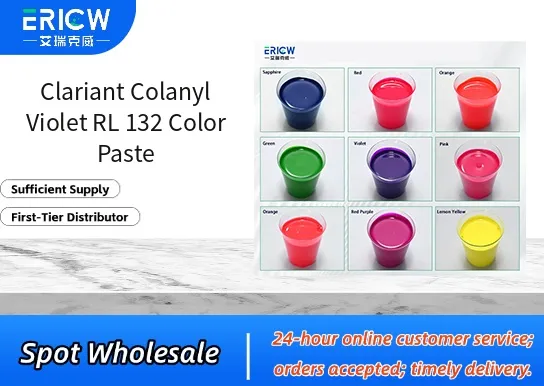
High chroma violet shade with excellent lightfastness and weather resistance.
Optimized for compatibility with water-based and solvent-based acrylic, vinyl, and polyester resin systems.
Low migration profile suitable for applications requiring regulatory compliance (e.g., EN 71-3, REACH).
Stable rheology and excellent dispersion stability in formulated coatings and inks.
Consistent batch-to-batch color reproducibility supported by Clariant’s global quality control standards.
Architectural and industrial waterborne coatings.
Automotive refinish coatings (basecoat and clearcoat systems).
Plastic coloration for interior automotive parts and consumer electronics housings.
Printing inks for flexible packaging and label applications.
Wood finishes and furniture coatings requiring high gloss and color fidelity.
| Chemical Type | Organic pigment dispersion (Violet 23) |
| Product Form | Liquid color paste |
| Appearance | Viscous, homogeneous violet paste |
| Primary Applications | Coatings, inks, and plastic coloration |
| Key Features | High tinctorial strength, low viscosity, excellent dispersibility |
| Benefits | Reduced grinding time, improved opacity, enhanced color consistency |
| Recommended Carrier System | Water and/or glycol ether-based media |
| Storage Conditions | Store at 5–30 °C; protect from freezing and direct sunlight |
Q1: What types of polymer systems is Colanyl Violet RL 132 Color Paste compatible with?
A: Colanyl Violet RL 132 is formulated for compatibility with a broad range of thermoplastics, including polyolefins (PP, PE), styrenics (PS, ABS), and engineering plastics such as PA and PC. It is not recommended for use in highly polar or reactive systems without prior compatibility testing.
Q2: How should this color paste be incorporated into the base polymer?
A: The paste is typically introduced via gravimetric or volumetric dosing directly into the extruder feed throat or melt stream. Pre-blending with carrier resin may improve dispersion uniformity, especially in high-viscosity or low-shear processing conditions.
Q3: Does this product offer good thermal stability during standard polymer processing?
A: Yes — Colanyl Violet RL 132 is engineered for robust thermal stability under typical compounding and injection molding conditions up to approximately 260 °C, maintaining consistent hue and minimal color shift across multiple processing cycles.
Q4: Is this color paste suitable for applications requiring food contact compliance?
A: Colanyl Violet RL 132 is designed for use in non-food-contact applications. For food-contact or pharmaceutical-grade requirements, please consult Clariant’s regulatory team to evaluate available compliant alternatives and confirm suitability per regional regulations.
Q5: What is the typical dosage range for achieving target shade intensity?
A: Dosage depends on formulation requirements and desired opacity, but it is generally used at low concentrations — typically ranging from 0.1% to 2% by weight relative to the base polymer — with optimal dispersion achieved through proper melt mixing.
Contact With Us:
E-mail: wangxingqiang@ericwchem.com
Have a Questions? Call Us:
Add:
Building A1, Jiete Industrial Park, Huangpu District, Guangzhou City, Guangdong Province, China