English
 Español
 tiếng việt
 русский
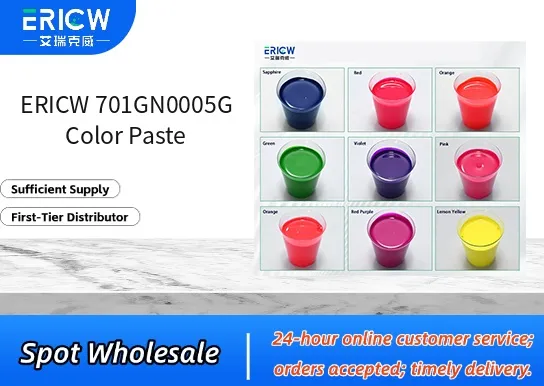
High chroma green pigment dispersion with excellent color strength and batch-to-batch consistency.
Optimized for compatibility with water-based acrylic, polyurethane, and epoxy resin systems.
Low volatile organic compound (VOC) content, supporting sustainable formulation requirements.
Thixotropic rheology ensures minimal settling and superior storage stability up to 24 months.
Non-hazardous classification per GHS; no heavy metals (Pb, Cd, Hg, Cr⁶⁺) detected.
Architectural coatings including interior/exterior wall paints and primers.
Industrial maintenance coatings for machinery, pipelines, and structural steel.
Automotive refinish basecoats and touch-up formulations.
Plastic coloration for ABS, PP, and PVC compounds in extrusion and injection molding.
Wood finishes and stains for furniture, flooring, and cabinetry.
| Chemical Type | Organic pigment dispersion (phthalocyanine green derivative) |
| Product Form | Liquid paste, ready-to-use |
| Appearance | Homogeneous, viscous green paste with glossy surface |
| Primary Applications | Water- and solvent-based coatings, plastics, inks |
| Key Features | Excellent lightfastness (ASTM D2804 Level 7), heat stability ≤180°C |
| Benefits | Reduced formulation time, improved tinting strength vs. dry pigment, lower dust exposure |
| Storage Conditions | Store at 5–30°C; protect from freezing and direct sunlight |
| Packaging | 5 kg HDPE pail, 25 kg composite drum, or IBC tote (1000 L) |
Q1: What is the primary application field for ERICW 701GN0005G Color Paste?
A: ERICW 701GN0005G is specifically formulated for coloring polyolefin-based compounds, including PP and HDPE, commonly used in injection molding, blow molding, and extrusion applications for consumer goods, automotive components, and industrial packaging.
Q2: Is this color paste suitable for food-contact applications?
A: ERICW 701GN0005G is designed to meet general regulatory expectations for food-contact plastics where permitted by local legislation; however, final compliance depends on the complete formulation, processing conditions, and applicable regional requirements. Users must conduct full regulatory validation for their specific application.
Q3: How should ERICW 701GN0005G be incorporated into polymer melts?
A: The paste is typically introduced via gravimetric or volumetric dosing systems directly into the extruder or injection molding machine feed throat. Pre-blending with base resin is not required, but thorough melt mixing is essential to ensure uniform dispersion and optimal color development.
Q4: What is the recommended dosage range for achieving target shade intensity?
A: Dosage generally ranges from 0.1% to 2% by weight relative to the base polymer, depending on desired opacity, chroma, and substrate characteristics. Lower concentrations are typical for light tints; higher loadings may be needed for deep, saturated tones or when masking natural polymer color.
Q5: Does ERICW 701GN0005G contain heavy metals or halogenated compounds?
A: This color paste is manufactured without intentionally added lead, cadmium, mercury, hexavalent chromium, or brominated/chlorinated flame retardants, aligning with common industry restrictions such as RoHS and REACH SVHC guidelines. Full substance declarations are available upon request for qualified customers.
Contact With Us:
E-mail: wangxingqiang@ericwchem.com
Have a Questions? Call Us:
Add:
Building A1, Jiete Industrial Park, Huangpu District, Guangzhou City, Guangdong Province, China