English
 Español
 tiếng việt
 русский
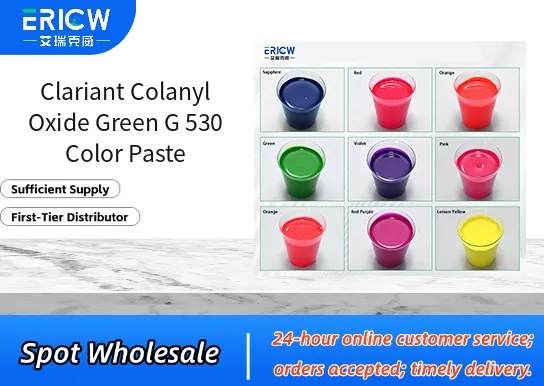
High chroma, stable oxide green shade with excellent lightfastness and weather resistance.
Optimized for low migration and minimal bleed in demanding polymer systems.
Ready-to-use liquid paste format ensures consistent dispersion and simplified dosing.
Compliant with major global regulatory frameworks including REACH and RoHS.
Designed for high-temperature processing stability up to 280 °C in polyolefins and engineering plastics.
Polypropylene (PP) and polyethylene (PE) packaging films and containers.
Automotive interior components requiring long-term color retention.
Household appliances and consumer electronics housings.
Technical injection-molded parts exposed to outdoor UV conditions.
Masterbatch production for OEM and compounder supply chains.
| Chemical Type | Inorganic oxide-based pigment dispersion |
| Product Form | Liquid color paste (solvent-free) |
| Appearance | Homogeneous green paste, free of visible grit or sediment |
| Primary Applications | Polyolefins, engineering thermoplastics, masterbatches |
| Key Features | Low migration, high thermal stability, excellent dispersibility |
| Recommended Carrier | PP/PE-compatible carrier system |
| VOC Content | <1% (w/w) |
| Storage Conditions | 15–25 °C, sealed container, avoid freezing |
Q1: What types of polymers is Colanyl Oxide Green G 530 compatible with?
A: Colanyl Oxide Green G 530 is formulated for use in polyolefins such as PP and PE, and shows good compatibility in engineering thermoplastics including ABS, PS, and certain polyamides. Performance in polar or highly crystalline systems should be verified via application testing.
Q2: How should this color paste be incorporated into a polymer melt process?
A: It is typically introduced via side-feeding or gravimetric dosing directly into the extruder throat or injection molding hopper. Pre-blending with carrier resin is optional but may improve dispersion uniformity in high-speed or sensitive processes.
Q3: Does this product contain heavy metals or restricted substances?
A: Colanyl Oxide Green G 530 is manufactured without intentionally added lead, cadmium, mercury, or hexavalent chromium, and complies with Clariant’s internal Restricted Substances List (RSL). Regulatory status for specific end-use markets (e.g., food contact, toys) requires case-by-case evaluation and documentation review.
Q4: What is the typical dosage range for achieving target shade intensity?
A: Dosage depends on base polymer, desired opacity, and processing conditions, but it is generally used at low concentrations—typically ranging from 0.1% to 2% by weight—to achieve full coverage and consistent green tones.
Contact With Us:
E-mail: wangxingqiang@ericwchem.com
Have a Questions? Call Us:
Add:
Building A1, Jiete Industrial Park, Huangpu District, Guangzhou City, Guangdong Province, China