English
 Español
 tiếng việt
 русский
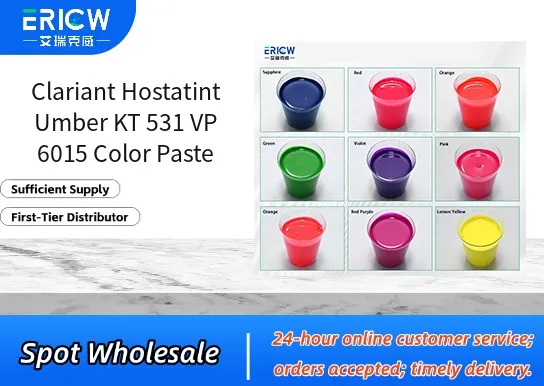
High chroma, stable umber shade with excellent batch-to-batch color consistency.
Optimized for high-shear dispersion in water-based systems without flocculation or settling.
Low volatile organic compound (VOC) content, supporting compliance with stringent environmental regulations.
Excellent lightfastness and thermal stability up to 180 °C for demanding processing conditions.
Compatible with common anionic and non-ionic surfactants, enabling broad formulation flexibility.
Architectural coatings including interior and exterior emulsion paints.
Industrial maintenance coatings for metal and concrete substrates.
Water-based wood stains and varnishes requiring natural earth-tone aesthetics.
Plastic coloration for extrusion and injection molding of polyolefins and PVC.
Printing inks for packaging applications where UV resistance and low migration are critical.
| Chemical Type | Inorganic iron oxide pigment dispersion |
| Product Form | Concentrated aqueous color paste |
| Appearance | Viscous, homogeneous brown paste |
| Primary Applications | Water-based and solvent-free coatings, plastics, inks |
| Key Features | Non-hazardous, REACH-compliant, heavy-metal-free |
| Benefits | Easy dosing, reduced dust exposure, improved workplace safety |
| pH (25 °C) | 7.5–8.5 |
| Storage Stability | ≥12 months at 5–30 °C in sealed original container |
Q1: What is the primary application field for Hostatint Umber KT 531 VP 6015?
A: This pigment paste is specifically developed for coloring polyolefin-based compounds, including PP and PE, in applications such as automotive interior parts, consumer goods, and industrial packaging where consistent earth-tone aesthetics and thermal stability during processing are required.
Q2: Is this color paste suitable for food-contact applications?
A: Hostatint Umber KT 531 VP 6015 is formulated to meet general regulatory expectations for indirect food contact in polyolefins, subject to final compliance verification by the compounder or end-user under applicable regional frameworks. It contains no intentionally added heavy metals or restricted substances above typical industry thresholds.
Q3: How should this paste be incorporated into a polymer melt?
A: It is designed for direct addition into the extruder feed throat or side-stuffer during compounding. Good dispersion is achieved at standard polyolefin processing temperatures (typically 180–240 °C), and pre-mixing with carrier resin is not required but may be considered for highly sensitive formulations.
Q4: Does this product offer good UV stability in outdoor applications?
A: Yes — the inorganic umber pigment system provides inherent resistance to UV degradation and thermal oxidation, making it suitable for semi-outdoor and long-term indoor applications where color retention is critical. For extended full-sun exposure, complementary UV stabilizers are recommended in the final formulation.
Q5: What is the typical dosage range when using this paste in PP compounds?
A: Dosage depends on the desired shade intensity and base polymer opacity, but it is generally used at low concentrations — typically ranging from 0.1% to 2% by weight — to achieve uniform, reproducible coloration without compromising mechanical properties.
Contact With Us:
E-mail: wangxingqiang@ericwchem.com
Have a Questions? Call Us:
Add:
Building A1, Jiete Industrial Park, Huangpu District, Guangzhou City, Guangdong Province, China