English
 Español
 tiếng việt
 русский
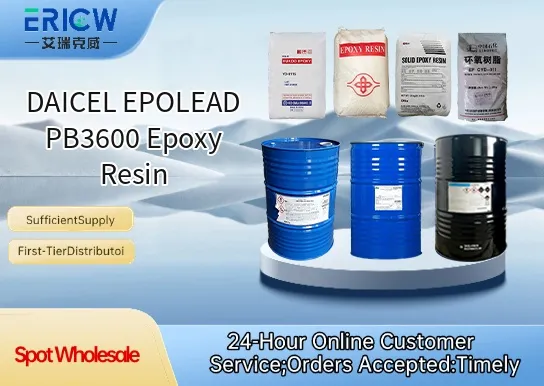
Highly reactive liquid epoxy resin with low viscosity for excellent processability and impregnation.
Designed for fast cure kinetics, enabling efficient high-speed composite manufacturing cycles.
Delivers superior mechanical strength and thermal stability in cured laminates.
Compatible with standard amine and anhydride curing agents used in industrial thermoset systems.
Low chloride content ensures enhanced electrical insulation properties and corrosion resistance.
Aerospace structural composites requiring high glass transition temperature (Tg) and dimensional stability.
Wind turbine blade matrices where fatigue resistance and resin flow control are critical.
Electrical insulation systems for high-voltage equipment and power transformers.
Automotive lightweight components including battery enclosures and under-hood structural parts.
Prepreg and infusion-grade carbon fiber composites for industrial and sporting goods applications.
| Chemical Type | Diglycidyl ether of bisphenol-A (DGEBA) type epoxy resin |
| Product Form | Clear to pale yellow low-viscosity liquid |
| Appearance | Transparent, homogeneous liquid at 25°C |
| Epoxy Equivalent Weight (EEW) | 185–195 g/eq |
| Viscosity (25°C) | 12,000–16,000 mPa·s |
| Chloride Content | ≤ 500 ppm |
| Softening Point | Not applicable (liquid at room temperature) |
| Primary Applications | Composite matrix resins, electrical encapsulation, high-performance laminates |
Q1: What is the primary function of DAICEL EPOLEAD PB3600 in epoxy formulations?
A: EPOLEAD PB3600 is a reactive liquid diluent designed to reduce viscosity and improve processability of standard bisphenol-A or bisphenol-F based epoxy resins without significantly compromising final crosslink density or thermal performance.
Q2: Is EPOLEAD PB3600 compatible with common amine and anhydride curing agents?
A: Yes — it exhibits broad compatibility with aliphatic and aromatic amines, as well as cyclic anhydrides, and participates directly in the curing reaction due to its terminal epoxy functionality.
Q3: How does PB3600 compare to conventional non-reactive diluents in terms of volatility and leaching risk?
A: Unlike non-reactive diluents, PB3600 chemically incorporates into the polymer network during cure, resulting in negligible volatility and significantly reduced potential for extractables or migration in end-use applications.
Q4: Can EPOLEAD PB3600 be used in food-contact or pharmaceutical packaging adhesives?
A: While PB3600 itself is not pre-approved for direct food contact, it may be considered in multilayer laminated structures where regulatory compliance is achieved through full formulation evaluation and appropriate migration testing under intended use conditions.
Q5: What handling precautions are recommended for safe industrial use?
A: As with most epoxy compounds, standard industrial hygiene practices apply — including use of nitrile gloves, eye protection, and adequate ventilation. Skin contact should be avoided, and prolonged inhalation of mists or vapors must be prevented.
Contact With Us:
E-mail: wangxingqiang@ericwchem.com
Have a Questions? Call Us:
Add:
Building A1, Jiete Industrial Park, Huangpu District, Guangzhou City, Guangdong Province, China