English
 Español
 tiếng việt
 русский
Excellent abrasion resistance for demanding mechanical environments.
Outstanding low-temperature flexibility down to –40 °C.
Good oil and grease resistance suitable for industrial fluid contact.
High transparency and optical clarity in thin-gauge extrusions and films.
Processable via standard thermoplastic equipment including extrusion, injection molding, and calendering.
Transparent protective films for electronics and touchscreens.
Flexible medical tubing requiring biocompatibility and clarity.
High-performance seals and gaskets in automotive under-hood applications.
Wear-resistant conveyor belts and industrial rollers.
Soft-touch overmolding for consumer electronics housings.
| Chemical Type | Aliphatic polyester-based thermoplastic polyurethane (TPU) |
| Product Form | Pellets |
| Appearance | Translucent, natural-colored granules |
| Density (ISO 1183) | 1.18–1.20 g/cm³ |
| Melt Flow Index (ISO 1133, 230 °C/5 kg) | 10–14 g/10 min |
| Shore A Hardness (ISO 868) | 85–87 |
| Tensile Strength (ISO 527-2) | 35–40 MPa |
| Elongation at Break (ISO 527-2) | 500–550 % |
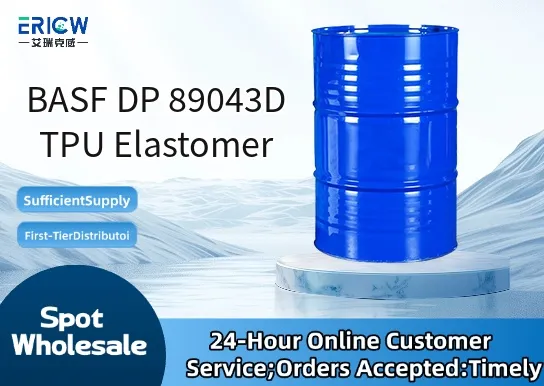
Q1: What is the primary application domain for BASF DP 89043D?
A: BASF DP 89043D is a thermoplastic polyurethane (TPU) elastomer specifically engineered for demanding extrusion and injection molding applications, with strong suitability in technical components requiring high abrasion resistance, flexibility at low temperatures, and consistent melt processability — commonly used in automotive interior trim, industrial hoses, and precision-molded seals.
Q2: Is DP 89043D compatible with common engineering thermoplastics like ABS or PC?
A: Yes, DP 89043D demonstrates good compatibility with several engineering thermoplastics, including ABS and polycarbonate, particularly in co-extrusion and overmolding configurations. Successful adhesion typically requires optimized processing conditions—such as controlled melt temperature gradients and appropriate residence time—to ensure interfacial bonding without degradation.
Q3: How should DP 89043D be dried prior to processing?
A: Like most hygroscopic TPUs, DP 89043D must be thoroughly dried before processing to prevent surface defects and molecular weight reduction. Recommended drying is at 80–90 °C for 2–4 hours using a desiccant dryer, with moisture content maintained below 0.05% for optimal melt stability and mechanical performance.
Q4: Does DP 89043D offer UV or hydrolysis resistance suitable for outdoor applications?
A: DP 89043D exhibits moderate inherent UV stability and improved hydrolytic resistance compared to conventional polyester-based TPUs, but prolonged outdoor exposure without stabilization or protective topcoating may lead to gradual surface embrittlement and discoloration. For extended exterior use, supplemental UV absorbers or HALS stabilizers are recommended.
Contact With Us:
E-mail: wangxingqiang@ericwchem.com
Have a Questions? Call Us:
Add:
Building A1, Jiete Industrial Park, Huangpu District, Guangzhou City, Guangdong Province, China