English
 Español
 tiếng việt
 русский
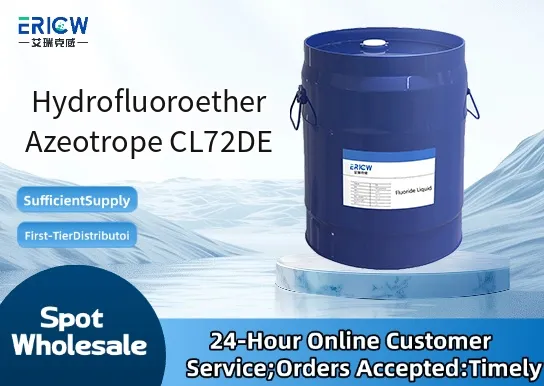
Zero ozone depletion potential (ODP = 0) and low global warming potential (GWP < 15).
Non-flammable under standard atmospheric conditions (ASTM D3278, Class IIIB).
Highly effective azeotropic behavior ensures consistent cleaning performance across vapor degreasing cycles.
Low surface tension and excellent solvency for light hydrocarbon residues, fluxes, and silicone oils.
Compatible with common elastomers and engineering plastics including Viton®, EPDM, and PTFE.
Vapor phase cleaning of precision optics and laser components.
Final rinse and drying in semiconductor wafer and MEMS manufacturing.
Cleaning of medical device assemblies prior to sterilization.
Removal of rosin-based and no-clean solder fluxes in electronics rework.
Low-residue degreasing of aerospace aluminum and titanium parts.
| Chemical Type | Azeotropic blend of hydrofluoroethers (HFEs), primarily HFE-7200 and HFE-7100 derivatives |
| Product Form | Liquid at room temperature (20–25°C) |
| Appearance | Clear, colorless, odorless liquid |
| Boiling Point (at 760 mmHg) | 49–51°C (azeotropic range) |
| Primary Applications | Vapor degreasing, precision rinsing, and drying |
| Key Features | Azeotropic stability, non-corrosive, non-conductive, residue-free evaporation |
| Regulatory Compliance | REACH registered; compliant with EU RoHS 2015/863; not listed under TSCA Significant New Use Rules (SNUR) |
| Storage Stability | Stable for ≥24 months in sealed, dry, ambient conditions |
| Common Compatible Systems | Suitability |
| Batch Vapor Degreasers (e.g., Precision Cleaning Systems Model VD-3000) | Highly Recommended – Optimized for azeotropic condensation and thermal stability |
| Inline Vapor Degreasing Lines (e.g., SMT CleanTech Inline-VD Series) | Recommended – Requires minor sump temperature calibration |
| Ultrasonic + Vapor Cascade Systems | Suitable – Use as final vapor rinse stage only; avoid prolonged ultrasonic exposure |
| Carbon Adsorption Recovery Units | Highly Recommended – High adsorption efficiency (>95%) and low desorption energy |
Q1: What is the CAS Registry Number for CL72DE?
A: CL72DE is a proprietary azeotropic formulation; individual components are assigned CAS numbers (e.g., HFE-7200: 132137-19-8), but the blend itself carries no single CAS number per IUPAC and regulatory convention.
Q2: Can CL72DE be used in existing chlorinated solvent equipment without modification?
A: Yes — CL72DE is fully compatible with standard stainless-steel vapor degreasers designed for chlorinated solvents; however, cold traps and refrigeration systems may require recalibration due to its lower boiling point and higher latent heat of vaporization.
Q3: How does CL72DE compare to n-Propyl Bromide (nPB) or Trans-1,2-Dichloroethylene (TCE) in terms of worker safety?
A: CL72DE exhibits significantly lower acute toxicity (LC50 > 20,000 ppm, 4-hr rat inhalation), no neurotoxicity concerns, and no reproductive hazard classification — unlike nPB (suspected neurotoxin) or TCE (known carcinogen, IARC Group 1).
Q4: Does CL72DE migrate into or extract plasticizers from PVC or polyurethane components?
A: No observable migration or extraction has been documented in validated testing (ISO 10993-12 simulated body fluid and IPA extraction studies); CL72DE shows minimal interaction with polar polymers under typical exposure durations (<10 min).
Contact With Us:
E-mail: wangxingqiang@ericwchem.com
Have a Questions? Call Us:
Add:
Building A1, Jiete Industrial Park, Huangpu District, Guangzhou City, Guangdong Province, China