English
 Español
 tiếng việt
 русский
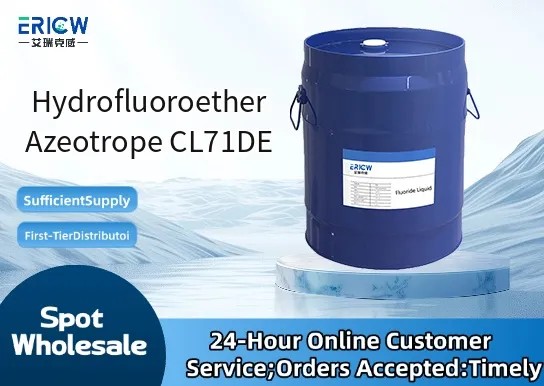
Zero ozone depletion potential (ODP = 0) and low global warming potential (GWP < 15), supporting sustainability compliance.
Nonflammable under standard operating conditions (flash point > 60 °C, ASTM D93), enhancing workplace safety.
High volatility and rapid evaporation kinetics enable residue-free drying in precision cleaning processes.
Chemically inert toward most metals, plastics, and elastomers—minimizing material compatibility risks.
Azeotropic behavior ensures consistent composition and performance across repeated distillation cycles in closed-loop systems.
Critical cleaning of aerospace components including avionics, sensors, and turbine assemblies.
Final rinse and drying for semiconductor photomasks, MEMS devices, and high-precision optics.
Flux residue removal from printed circuit board (PCB) assemblies prior to conformal coating or testing.
Defluxing and moisture displacement in medical device manufacturing cleanrooms (ISO Class 5–7).
Carrier solvent for vapor phase soldering and low-residue thermal management fluid formulations.
| Chemical Type | Azeotropic mixture of hydrofluoroethers (HFEs) |
| Product Form | Liquid at room temperature (20 °C) |
| Appearance | Clear, colorless, odorless liquid |
| Melting Point | Approx. –85 °C (estimated, non-crystalline) |
| Boiling Point (at 760 mmHg) | Approx. 49–51 °C (azeotropic range) |
| Primary Applications | Precision vapor degreasing, low-residue rinsing, moisture displacement |
| Key Features | Nonflammable, zero ODP, low GWP, azeotropic stability |
| Regulatory Compliance | REACH registered; compliant with EPA SNAP Program (acceptable substitute for CFCs/HCFCs) |
| Common Compatible Systems | Suitability |
| Vapor degreasing equipment (e.g., Precision Cleaning Systems Model VD-3000) | Highly Recommended – Optimized for azeotropic boiling profile and condenser recovery efficiency |
| Ultrasonic cleaning systems with HFE-compatible tanks (stainless steel or PTFE-lined) | Recommended – Requires temperature control ≤ 50 °C to maintain azeotrope integrity |
| Batch immersion cleaners with solvent recovery distillation units | Suitable – Compatible with stainless-steel stills and glycol-cooled condensers |
| Automated spray-in-air cleaning lines (non-pressurized nozzles) | Recommended – Low surface tension enables uniform coverage without overspray residue |
Q1: What is the CAS Registry Number for CL71DE?
A: CL71DE is a proprietary azeotropic formulation and does not carry a single CAS number; its primary constituents are registered under CAS No. 163702-07-6 (HFE-7100) and CAS No. 422-56-0 (HFE-7200), blended to meet strict azeotropic specifications.
Q2: What is the recommended usage concentration in vapor degreasing applications?
A: CL71DE is used neat (100% concentration) in vapor degreasing—no dilution required. Its azeotropic nature ensures stable vapor phase composition and consistent cleaning efficacy across operational cycles.
Q3: How does CL71DE compare to HFE-7100 or HFE-7200 individually?
A: Unlike individual HFEs, CL71DE exhibits a true azeotrope—eliminating fractionation during boiling, improving process repeatability, reducing solvent loss, and enabling higher recovery rates (>95%) in closed-loop systems.
Q4: Is CL71DE approved for use in regulated electronics manufacturing (e.g., IPC-J-STD-033)?
A: Yes—CL71DE meets IPC-J-STD-033 requirements for moisture-sensitive device cleaning and has been validated for residual halide levels < 0.1 µg/cm² (per IPC-TM-650 2.3.25), ensuring compatibility with MSL 1–6 components.
Q5: Does CL71DE migrate into porous substrates or leave extractable residues on sensitive polymers?
A: No significant migration or extractables observed per USP <87>/<88> cytotoxicity screening and GC-MS analysis of leachates from polyimide, PTFE, and silicone elastomers after exposure and drying.
Contact With Us:
E-mail: wangxingqiang@ericwchem.com
Have a Questions? Call Us:
Add:
Building A1, Jiete Industrial Park, Huangpu District, Guangzhou City, Guangdong Province, China