English
 Español
 tiếng việt
 русский
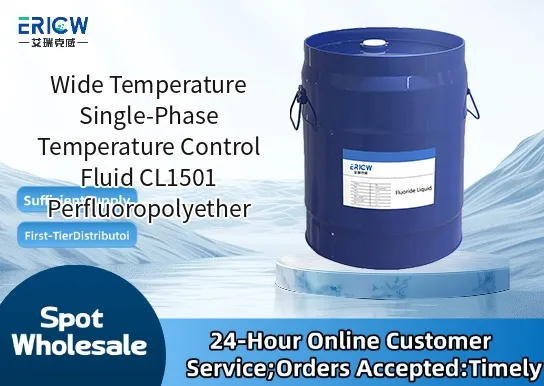
Exceptionally broad operational temperature range: stable single-phase performance from –70 °C to +200 °C.
Chemically inert perfluoropolyether (PFPE) base fluid with outstanding resistance to oxidation, acids, bases, and halogens.
Non-flammable, zero vapor pressure at room temperature, and inherently non-reactive with most elastomers and metals.
Low outgassing and ultra-low volatility — qualified for high-vacuum and cleanroom-critical thermal management applications.
Hydrophobic and lipophobic — prevents moisture absorption and resists contamination from hydrocarbon-based fluids.
Thermal testing of aerospace avionics and satellite components under extreme ambient cycling.
Temperature calibration baths and precision thermostatic circulators in metrology laboratories.
Cooling and heating media for semiconductor process equipment, including etch and CVD chamber thermal control.
Dielectric heat-transfer fluid in high-reliability power electronics and laser diode cooling systems.
Long-duration thermal soak and environmental stress screening (ESS) of medical device assemblies and MEMS sensors.
| Chemical Type | Perfluoropolyether (PFPE), linear K-type structure |
| Product Form | Ambient-stable clear liquid |
| Appearance | Colorless, transparent, odorless liquid |
| Melting Point | –70 °C (typical, onset) |
| Boiling Point (at 760 torr) | Decomposes above 300 °C without boiling; no defined BP |
| Density (25 °C) | 1.82–1.86 g/cm³ |
| Dynamic Viscosity (25 °C) | 150–170 cSt |
| Regulatory Compliance | REACH SVHC-free; RoHS 2015/863 compliant; no listed TSCA or IARC hazards |
| Common Compatible Systems | Suitability |
| Stainless steel (316L) circulating chillers & heaters | Highly Recommended – No corrosion or degradation observed after 5,000 hrs continuous operation |
| Viton® (FKM) and Chemraz® seals/gaskets | Highly Recommended – Minimal swell (<5%) and full elastomer integrity retained |
| Aluminum 6061 and titanium alloy (Grade 2/5) cold plates | Recommended – Passivates surface; no pitting or galvanic acceleration |
| Fluorinated ethylene propylene (FEP) and perfluoroalkoxy (PFA) tubing | Highly Recommended – Zero extractables, ideal for ultra-high-purity loops |
Q1: What is the CAS Registry Number for CL1501?
A: The CAS number for CL1501 is 60168-88-9 (representative for K-type PFPE oligomer mixture meeting CL1501 specifications).
Q2: Is CL1501 suitable for direct contact with pharmaceutical manufacturing surfaces?
A: CL1501 is not FDA-approved for direct food or pharmaceutical contact; however, it is widely used in closed-loop thermal control of API synthesis reactors and lyophilizers where indirect heat transfer is employed and validated per USP <87>/<88>.
Q3: How does CL1501 compare to standard silicone oils in terms of thermal stability and vacuum compatibility?
A: CL1501 offers superior thermal stability (>300 °C decomposition vs. ~200 °C for dimethyl silicones) and significantly lower total mass loss (<0.1% at 200 °C/24h per ASTM E595) — making it preferred for UHV and space-grade applications where silicone outgassing is unacceptable.
Q4: Are there known migration or leaching concerns when CL1501 contacts polyimide or polyether ether ketone (PEEK) components?
A: No measurable migration or chemical interaction has been observed with polyimide or PEEK under static or dynamic conditions up to 180 °C; both polymers retain >98% tensile strength and dimensional stability after 1,000 hrs immersion.
Contact With Us:
E-mail: wangxingqiang@ericwchem.com
Have a Questions? Call Us:
Add:
Building A1, Jiete Industrial Park, Huangpu District, Guangzhou City, Guangdong Province, China