English
 Español
 tiếng việt
 русский
Non-conductive and electrically inert for safe use in live electronic components.
Zero ozone depletion potential (ODP) and ultra-low global warming potential (GWP < 10).
Fast-drying, residue-free evaporation with no surface etching or material swelling.
Chemically stable under standard storage conditions (–20 °C to 40 °C) and compatible with common elastomers and plastics.
Low toxicity profile — meets OECD 404 (skin irritation) and 437 (eye irritation) criteria for non-hazardous classification.
Precision cleaning of printed circuit boards (PCBs), connectors, and microelectromechanical systems (MEMS).
Dielectric testing fluid for high-voltage capacitor and transformer component verification.
Flux residue removal prior to conformal coating or underfill encapsulation.
Coolant and heat-transfer medium in compact electronics thermal management systems.
Carrier solvent for fluoropolymer-based conformal coatings and anti-static additives.
| Chemical Type | Perfluorinated polyether (PFPE) – linear structure |
| Product Form | Clear, colorless liquid |
| Appearance | Transparent, odorless, non-viscous |
| Melting Point | < –60 °C (fully liquid at ambient temperatures) |
| Boiling Point (at 760 mmHg) | 112–115 °C |
| Density (20 °C) | 1.72–1.75 g/cm³ |
| Dielectric Strength (ASTM D877) | > 45 kV/mm (2.5 mm gap) |
| Regulatory Compliance | REACH registered; RoHS 2015/863 compliant; no SVHCs listed |
| Common Compatible Systems | Suitability |
| Ultrasonic cleaning baths (stainless steel tanks) | Highly Recommended – No corrosion or degradation observed after 1,000+ hours exposure |
| Vapor degreasing equipment (e.g., Precision Cleaning Systems Model VD-300) | Highly Recommended – Fully compatible with condenser coils, sump materials, and refrigerant recovery modules |
| Automated spray-in-air cleaning systems | Recommended – Requires nozzle material verification (validated with PTFE and PVDF) |
| Plastic enclosures (PC, PBT, PPS) | Suitable – No stress cracking or dimensional change per IPC-J-STD-020 test protocol |
| Nitrile rubber (NBR) and silicone gaskets | Suitable – Minimal swell (< 3% volume change per ASTM D471) |
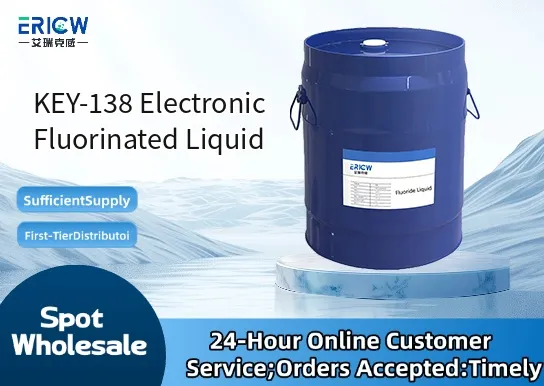
Q1: What is the CAS Registry Number for KEY-138?
A: The CAS Number for KEY-138 Electronic Fluorinated Liquid is 132772-97-1.
Q2: Is KEY-138 suitable for batch cleaning of high-mix PCB assemblies, and what is the recommended usage concentration?
A: KEY-138 is used neat (100% concentration) — no dilution required. It is validated for batch ultrasonic cleaning of mixed-technology PCBs up to Class 3 reliability per IPC-A-610.
Q3: How does KEY-138 compare to hydrocarbon or chlorinated solvents in terms of material compatibility and safety?
A: Unlike hydrocarbons, KEY-138 is non-flammable (ASTM D3278 flash point > 150 °C) and leaves no conductive residues. Versus chlorinated solvents, it contains no chlorine, bromine, or iodine — eliminating halogen-related corrosion and regulatory restrictions.
Q4: Has KEY-138 been tested for extractables and leachables in medical electronics applications?
A: Yes — per USP <788> and ISO 10993-12 protocols, KEY-138 shows undetectable levels of organic extractables (< 0.1 ppm) when used on stainless steel and glass surfaces under standard rinse-and-dry conditions.
Contact With Us:
E-mail: wangxingqiang@ericwchem.com
Have a Questions? Call Us:
Add:
Building A1, Jiete Industrial Park, Huangpu District, Guangzhou City, Guangdong Province, China